Home › Guides › Metal and Wood 3D Puzzles
Metal and Wood 3D Puzzle Kits: Piececool, ROKR, UGEARS
BuildAnArmy is reader-supported. When you buy through our Amazon links we may earn a commission, at no extra cost to you. How this works.
A 3D puzzle kit starts as a few flat sheets and ends as a standing model. The parts are precision-cut from metal or plywood, you press them out, and they lock together with tabs, slots and pegs. There is usually no glue and no paint. This guide explains how the metal and wood versions differ, which tools help, what the working wooden mechanisms do, and who each kind suits.
Two kinds of 3D puzzle
Metal sheet puzzles, such as Piececool's, use thin metal sheets with tiny parts cut into them. You bend and fold each part into shape, then join parts with small tabs. The result is a compact, finely detailed desk model. The catalog includes Piececool warships such as Bismarck, the battleship Fuso, the carrier USS Enterprise CVN-65, HMS Victory and a submarine, plus weapons like the Kar98k, M16A1, AK-47, AWM, Barrett M82A1 and a revolver.
Laser-cut wood kits, from ROKR, UGEARS and several other brands, use plywood sheets. The parts are thicker and larger, they fit together with pegs and slots, and many kits include moving parts: triggers, magazines, gears and, on some, a rubber-band firing mechanism. The catalog has wooden rifles, pistols, revolvers, a Gatling gun, a field cannon and an anti-aircraft gun.
| Metal sheet puzzle | Laser-cut wood kit | |
|---|---|---|
| Joining method | Tabs bent through slots | Pegs, slots and friction fits |
| Model size | Small, desk-sized | Often larger, some close to life size |
| Moving parts | Rarely | Common |
| Main skill | Fine bending and patience | Following steps and fitting parts |
| Key tools | Fine pliers, tweezers | Hobby knife, sanding stick |
| Fires anything? | No | Some kits shoot rubber bands |
How tab-and-slot metal assembly works
Each metal part is held in its sheet by a few very thin connecting points. You free a part by flexing it gently until those points break, or by cutting them. The part then has to be shaped. Fold lines are partly cut through the metal, so the sheet bends cleanly along them. Curved parts, such as a ship's hull sides or a rifle's barrel, are rolled around something round.
Parts are joined by small tabs on one piece that pass through matching slots on another. Once a tab is through, you twist it or fold it flat, and that locks the two parts together. Whole models are built this way, from the inside out, one sub-assembly at a time.
A few rules make the difference between a clean build and a frustrating one:
- Twist each tab once. Metal weakens when you bend it back and forth. A tab twisted, untwisted and twisted again can snap off. Get the parts aligned first, then lock the tab in one move.
- Bend only on the fold lines. If a part bends in the wrong place, the kink rarely comes out completely.
- Roll curves gradually. Use a pen, a dowel or a drill shank of the right size, and work the curve in slowly from one end.
- Handle the parts by their edges. Bare metal shows fingerprints. Some builders wear thin cotton gloves, or wipe the model with a microfiber cloth at the end.
- Fix broken tabs with a tiny drop of superglue. Apply it with a toothpick, not straight from the tube.
Tip: Before you twist any tab on a sub-assembly, insert all of its tabs loosely. Check that everything lines up, then lock them in order. Fixing a misaligned part after the tabs are twisted risks breaking them.

Piececool Bismarck Battleship
Bismarck is one of the most famous warships of WWII, and her long, low hull with four twin turrets is easy to recognize even as a small metal model. This Piececool kit suits anyone who wants a detailed display piece without paint or glue.
Check price on AmazonFor the real ship's story and her camouflage, see our Bismarck history and model kits guide.
Tools that help with metal puzzles
Some kits include basic tools, but better ones make a big difference to the result. Check the listing to see what comes in the box.
- Fine-tip flat-nose pliers for bending, folding and twisting tabs. Choose smooth jaws rather than serrated ones, which scar the finish.
- Round-nose pliers for tight curves.
- Fine tweezers to hold and place the smallest parts. Angled tips help you reach inside a model.
- A flush cutter rated for metal to free parts cleanly. Do not use a plastic sprue cutter on metal; it can damage the blades.
- A tray to catch small parts, and good light. A magnifier helps on the tiniest tabs.

Tamiya HG Angled Tweezers
Fine, angled tweezers let you hold a tiny metal part steady while you guide its tab into a slot, and they reach inside a model where fingers cannot. The same tweezers are useful for decals and small parts on plastic kits too.
Check price on AmazonThe edges of freshly cut metal parts can be sharp. Work slowly, keep your fingers clear of the pliers, and do the build at a table rather than on your lap.
Laser-cut wood kits and their mechanisms
Wood kits are built from plywood sheets in which every part has been cut by laser. You press each part out, and it fits to the next with pegs, slots and friction. ROKR and UGEARS are known for kits with working mechanisms, and that is much of their appeal. A wooden rifle might have a trigger that clicks, a magazine that slides out or a bolt that moves. Other brands in the catalog include Amiyi, Guava Bella, Flytohom, Kaptein and more. Their kits range from simple display models to piece counts in the hundreds; the Amiyi Gatling gun is listed at 344 pieces and the ROKR submachine gun at 275.
Practical points for wood kits:
- Press parts out gently and support the sheet around the part. Thin wooden parts can crack if you force them.
- Trim leftover tabs with a hobby knife, and sand them flush so parts sit properly.
- Sand tight fits; do not force them. A peg that is too tight can split the part. A light pass with a sanding stick usually solves it.
- Glue loose joints sparingly. Most kits need no glue, but a drop of wood glue can fix a joint that has worn loose.
- Wax moving parts. Rubbing a little candle wax or paraffin on gear teeth and axles is a common way to make wooden mechanisms run smoothly.
Laser cutting leaves slightly darkened edges and a faint smell of burnt wood. That is normal. You can leave the wood natural, or stain or paint it once the model is complete, as long as you keep finish out of the moving parts.
Rubber-band shooters and safety
Some wooden kits are built to shoot rubber bands. The ROKR AK-47 in the catalog is listed as a rubber-band rifle, and other wooden gun kits may include a similar mechanism. Check each listing to see whether a kit is display-only or shoots. Metal puzzles do not fire anything, and neither do the die-cast and plastic weapon models on this site.
A rubber band fired from a mechanism moves fast enough to hurt an eye. Treat these kits with the same care as any toy that launches something:
- Never aim at faces, people or pets. Shoot at paper targets, empty cans or a cardboard box.
- Wear eye protection when testing the mechanism or playing target games.
- Supervise children and follow the age guidance on the listing.
- Keep them at home. Wooden models are clearly not real, but a gun shape carried in public can still alarm people.
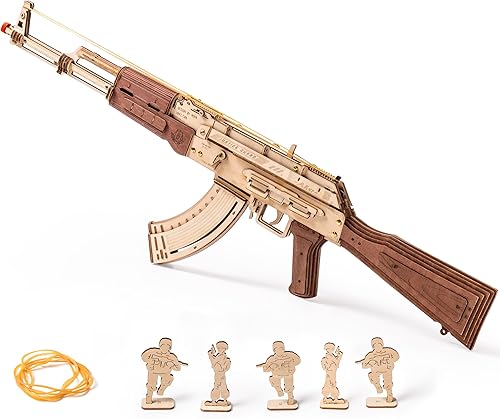
ROKR AK-47 Rubber-Band Rifle
A laser-cut wooden AK-47 that shoots rubber bands, according to its name. The build is part of the fun, and the finished mechanism adds play value. Use it for target practice with eye protection, and never aim it at people or pets.
Check price on Amazon
ROKR Thompson Tommy Gun

UGEARS Wolf-01 Handgun

Amiyi Gatling Gun, 344 Pieces

Kaptein Field Cannon
Difficulty and build time
Difficulty depends more on the number and size of parts than on the material. As a rough guide:
- Small metal puzzles, such as a pistol or a revolver, are a single evening or a weekend afternoon for most adults.
- Complex metal models, like a battleship with multiple turrets, masts and fine railings, take several sessions. The bending and tab work is slow, and it rewards stopping before your hands get tired.
- Wooden gun kits in the 200 to 350 piece range usually take a few evenings. Mechanisms need care, because a misplaced gear or spring stops the action working.
Read the instructions all the way through before you start, and test each moving sub-assembly as soon as it is built. Fixing a jammed trigger is far easier before it is buried inside the stock.

Piececool Kar98k Rifle

Piececool M16A1 Assault Rifle
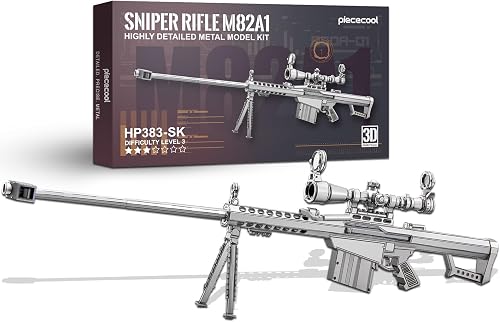
Piececool Barrett M82A1 Sniper Rifle

Piececool Revolver
Who they suit
Metal puzzles suit patient adults and older teens who like fine detail and small displays. They are a good choice when space is short, when you want a finished look without painting, or as a gift for an office desk. Their tiny parts and sharp edges make them a poor fit for young children.
Wood kits suit teens and adults who enjoy mechanisms and a hands-on build. They work well as a shared project for a parent and an older child, with an adult handling any rubber-band testing. For age-by-age advice, see military models for kids by age.
If you want a heavier, quicker metal model, read die-cast metal build kits explained. For a long-term wood project, look at wooden ship model kits. The model kit types compared hub shows how puzzles stack up against plastic kits, block sets and RC models.
Quick answers
Do metal 3D puzzles need glue?
No. Parts lock together with tabs that you twist or fold. A tiny drop of superglue is useful only if a tab breaks.
Can I twist a metal tab back if I make a mistake?
Once, carefully. Each extra twist weakens the metal and the tab may snap. Align everything before you lock it.
Do wooden gun kits really shoot?
Some shoot rubber bands, such as the ROKR AK-47 rubber-band rifle. Many are display-only. Check the listing. Never aim one at people or pets, and wear eye protection.
Which is easier, metal or wood?
Wood kits are usually easier for beginners because the parts are bigger. Metal puzzles need fine bending and steady hands.
Can I paint a 3D puzzle?
Wood kits can be stained or painted once finished, keeping finish away from moving parts. Metal puzzles come pre-finished and are normally left as they are.
Keep reading
 Types
Model Types Compared: Plastic Kits, Block Sets, Die-Cast and RC
Plastic kits, block sets, die-cast, 3D puzzles or RC? Compare build time, tools, skill, detail, durability and display size to pick the right…
Read guide Types
Plastic Model Kit Difficulty: How to Tell How Hard a Kit Is
How hard is that model kit? Learn to judge difficulty from skill ratings, part count, scale, tracks, clear parts, photo-etch, decals and tooling…
Read guide Types
Die-Cast and Metal Build Kits Explained: Guns, Cannons and More
What die-cast and metal build kits are: Goat Guns miniatures, Massimo Precision, Civil War cannon kits, tools, build time, finishes, display and safe…
Read guide