Home › Guides › Military Models for Kids
Military Models for Kids: Which Type Fits Which Age
BuildAnArmy is reader-supported. When you buy through our Amazon links we may earn a commission, at no extra cost to you. How this works.
A tank, plane or battleship model can be a child's first step into history and into making things with their hands. The trick is matching the type of model to the child. A set that is too hard ends in frustration, and one with the wrong tools or batteries can be unsafe. This guide breaks the choices down by age, explains the safety side, and shows how to make a first build go well.
Start with the age on the box
Every product in this guide carries a manufacturer's age rating, and that rating is the rule. It reflects small parts, sharp edges, tools, batteries and how complex the build is. Treat our age bands as a rough map of what children can usually handle, then check the rating on the listing and the box. If the stated age is above your child's age, wait or choose something else, however keen they are. Ratings vary a lot within one type: a small block set and a large one from the same brand can carry very different ages.
Age is also only part of the picture. A patient eight-year-old who loves detail may manage more than an impatient twelve-year-old. The rating sets the floor; your child's patience and experience decide how far above it to go.
At a glance
| Age (rough) | Good fits, if the box rating allows | Adult role |
|---|---|---|
| 6 to 8 | Small block sets, simple infrared RC tanks | Sit alongside, help find parts |
| 8 to 11 | Larger block sets, snap or click kits, toy-grade RC | Help with tricky steps, handle any cutting |
| 12 to 14 | Glued plastic kits, brush painting, bigger RC | Supervise knives, cement and charging |
| 15 and up | Detailed kits, die-cast build kits, hobby-grade RC | Coach, then step back |
Ages 6 to 8: bricks and simple RC
At this age, the best military "model" is one that needs no tools at all. Building block sets are the natural choice: the instructions are picture-based, mistakes are easy to undo, and the finished model can be played with. Be aware that many realistic military block sets are rated older than this, because of their part counts and small pieces, so this band is where checking the box matters most. Choose small sets with a few hundred pieces or fewer.
For RC, small infrared battle tanks are the right style for this age when the rating fits. They fire nothing but light, so a living-room battle is safe. Avoid anything that shoots BBs or gel beads, and anything with a LiPo battery. Plastic kits that need a knife and cement are not a good fit yet; their box ratings are usually higher anyway.

Mattel Mega Construx Fighter Jet, 223 Pieces
A Mega Construx fighter jet with 223 pieces, a manageable size for a younger builder. Mega is a mainstream toy brand, so the build is designed with play in mind. Check the age rating on the listing before you buy.
Check price on AmazonAges 8 to 11: block sets and snap kits
This is the golden age for block sets. Children can follow longer instructions and finish sets of several hundred pieces on their own, and specialist brands such as COBI make historical tanks, aircraft and ships with accurate markings. Our block sets guide explains the brands.
It is also the age for a first "real" model kit, in its easiest form. Snap kits, such as Revell's SnapTite and Easy-Click ranges, press together without glue. Parts are still on frames, so a child needs a pair of sprue cutters; an adult can do the cutting, or teach a careful child to use cutters while an adult watches. Many snap kits are molded in color or have stickers, so painting is optional.
Toy-grade RC tanks in the 1/24 size work well here, as long as the age rating fits. If a tank fires BBs, check the rating carefully; BB-firing toys usually carry higher ages.
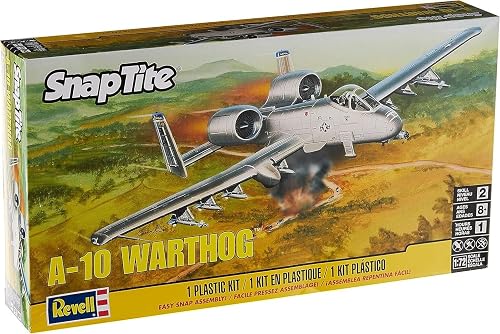
Revell A-10 Warthog, SnapTite
A 1/100 A-10 Warthog from Revell's SnapTite range. The parts press together without glue and the small scale keeps the build short, which is what you want for a first kit. Check the listing for the age rating and what is in the box.
Check price on Amazon
COBI Sturmpanzerwagen A7V, 119 Pieces
A 119-piece COBI A7V, the German tank of the First World War. A short build that introduces a child to a real piece of history. Confirm the box age suits your child.
Check price on Amazon
Sluban Merkava Tank, 344 Pieces

Sluban H2 Assault Vehicle, 265 Pieces

Sluban M38 Jeep

SKEKECIE Infrared Battle Tanks 2-Pack
Ages 12 to 14: glued kits with an adult nearby
Around this age, many children are ready for traditional plastic kits with cement and paint, when the box rating allows. Choose a kit with a modest part count from a brand known for good fit. A 1/48 tank or a single-engine fighter is a sensible size: big enough to handle, small enough to finish. Our kit difficulty guide explains how to read skill levels, and how to build your first model kit lists the basic tools.
Brush painting with water-based acrylics is the right first step. It is low in odor, cleans up with water and teaches patience. Bigger toy-grade RC models and simple park-flyer aircraft can also suit this age, with an adult handling any LiPo charging.

Tamiya M4A3E8 Sherman Easy Eight
A 1/48 Tamiya M4A3E8 Sherman Easy Eight. Tamiya is known for parts that fit well, which matters a lot on a first glued kit, and 1/48 keeps the build compact. Check the box age and plan to supervise the knife and cement.
Check price on AmazonAges 15 and up: almost everything
Most older teens can handle the full range when ratings allow: detailed plastic kits, airbrushing with good ventilation, larger block sets, metal and wood puzzle kits, and hobby-grade RC. Die-cast metal build kits, such as the miniature weapons from Goat Guns, often carry teen ratings because of their small metal parts and tools. Metal and wood puzzle kits also tend to be rated for older builders.
Weapon models deserve one extra conversation. They are non-firing display models, but some look realistic. Keep them at home, and never carry them in public, where they could be mistaken for the real thing.
For RC aircraft in the US, every recreational flyer must pass the FAA's free TRUST test, and models over 250 grams must be registered. If the owner is under 13, a person 13 or older has to register the model. Our RC models guide covers this in more detail.
Supervision and safety
- Knives: younger children should not use hobby knives. Sprue cutters are much safer for removing parts. When a child is ready for a knife, teach them to cut away from their body on a cutting mat, and dispose of used blades safely.
- Cement and paint fumes: plastic cement is a solvent. Use it in a ventilated room, keep the cap on between uses, and let an adult control the bottle for younger builders. Snap kits avoid cement entirely. Spray primer should be an adult job, done outdoors or in a well-ventilated space.
- Small parts: most model kits and block sets contain parts small enough to choke a young child. Build away from toddlers and pets, and sweep the floor afterward.
- Coin batteries: some small remotes use button or coin cells, which are dangerous if swallowed. Keep spares out of reach and make sure battery covers are screwed shut.
- BBs: everyone nearby wears safety glasses, nobody aims at people or pets, and spent BBs get picked up.
- LiPo batteries: an adult should charge them, on a fire-safe surface, never unattended and never overnight. Retire any battery that swells.
Tip: Set up a "build tray," such as a baking tray or a shallow box lid. Small parts stay contained, the table stays clean, and an unfinished model can be moved off the table between sessions.
How to make a first build succeed
- Let the child choose the subject. A model of a tank or plane they already love is the biggest motivation there is.
- Pick the right size. Choose a modest part count and a box rating at or below their age. A finished small model beats an abandoned big one.
- Read the instructions together first, so there are no surprises halfway through.
- Prepare the space: good light, a cutting mat or tray, the tools laid out, and nothing toddlers can reach.
- Keep sessions short. Stop while it is still fun, and leave the model where they can see it.
- Let them do the work. Resist the urge to fix things. A slightly crooked part they glued themselves means more than a perfect one you did.
- Make painting optional. An unpainted snap kit is still a finished model. Painting can be the next project.
- Display it. A shelf for finished models tells a child their work matters.
Building together as a family
Model building works well as a shared project. Split the jobs by age: an adult or older sibling handles cutting and gluing, a younger child finds parts and applies stickers, and everyone helps with painting. Larger block sets are easy to split, with one person on the hull and another on the turret.
The history makes it richer. Before you build, look at photos of the real vehicle and talk about where it served and who crewed it. Pitch the conversation at their level; military history includes hard subjects, and kids often ask good questions. A visit to a museum with real tanks or aircraft is a great follow-up. For gift ideas, see gifts for military history fans, and for an overview of every kind of model, read model kit types compared.
Quick answers
What is the best first military model for a child?
For most children, a small block set or a snap kit is the best start, as long as the box age rating fits. Both need no glue and give a finished model quickly.
Can my child build a model above the box age if I help?
Follow the manufacturer's rating. It covers small parts, tools and batteries, not only difficulty. Choose a product rated for your child's age instead.
At what age can kids use plastic cement?
Follow the rating on the kit and cement, and supervise closely. Many families start glued kits in the early teens, with an adult nearby and good ventilation.
Are BB-firing RC tanks OK for kids?
Only at or above the box age, and only with safety glasses for everyone nearby. Infrared battle tanks are the safer choice for younger children.
Do kids need paint for a model kit?
No. Snap kits and block sets look good unpainted. Glued kits look best painted, and water-based acrylics are the easiest place to start.
Keep reading
 Types
Model Types Compared: Plastic Kits, Block Sets, Die-Cast and RC
Plastic kits, block sets, die-cast, 3D puzzles or RC? Compare build time, tools, skill, detail, durability and display size to pick the right…
Read guide Types
Plastic Model Kit Difficulty: How to Tell How Hard a Kit Is
How hard is that model kit? Learn to judge difficulty from skill ratings, part count, scale, tracks, clear parts, photo-etch, decals and tooling…
Read guide Types
Die-Cast and Metal Build Kits Explained: Guns, Cannons and More
What die-cast and metal build kits are: Goat Guns miniatures, Massimo Precision, Civil War cannon kits, tools, build time, finishes, display and safe…
Read guide