Home › Guides › Best WWII Fighter Plane Kits
The Best WWII Fighter Plane Model Kits
BuildAnArmy is reader-supported. When you buy through our Amazon links we may earn a commission, at no extra cost to you. How this works.
Single-seat fighters are the most popular subjects in aircraft modeling. They are compact, they have famous stories, and you can finish one in a few evenings. Here are the kits we would recommend, organized by the aircraft rather than the brand, because most people start with the plane they love.
Which scale for fighters?
1/48 is the sweet spot: a P-51 Mustang is about 20 cm long, big enough for a detailed cockpit and easy to handle. 1/72 is smaller and great if you want to build a whole collection without running out of shelf space. 1/32 makes a large, impressive model with room for lots of detail, at a higher price and with more parts. See our scale guide for how they compare.
P-51 Mustang
The long-range escort fighter that changed the air war over Europe. The bubble-canopy P-51D is the most recognizable version; the earlier P-51B has the framed "birdcage" canopy.

Tamiya P-51D Mustang, 8th Air Force
A 1/48 P-51D in 8th Air Force markings. It is a well-proven kit with good fit and a crisp cockpit, and it is one of the most common first aircraft kits for good reason.
Check price on Amazon
Tamiya P-51B Mustang

Tamiya P-51D Mustang

Tamiya P-51D Mustang
Supermarine Spitfire
The elegant elliptical-wing fighter of the Battle of Britain. Early Mk.I versions have the classic look; the Mk.IX was the most important later variant.

Tamiya Spitfire Mk.I
A modern 1/48 Spitfire Mk.I. Modern toolings capture the shape of the wing well, and this one is a pleasure to build.
Check price on Amazon
Revell Spitfire Mk.IXc

COBI Supermarine Spitfire Mk.IXe
Messerschmitt Bf 109 and Focke-Wulf Fw 190
Germany's two main single-engine fighters. The Bf 109 flew from the Spanish Civil War to 1945; the Fw 190 arrived in 1941 and surprised the RAF with its performance.

Tamiya Messerschmitt Bf109G-6
A 1/48 Bf 109G-6, the most-produced version of the most-produced fighter of the war. Easy to paint in grey camouflage with yellow ID markings.
Check price on Amazon
Revell Messerschmitt Bf109 G-10

Tamiya Focke-Wulf Fw190 A-8/A-8 R2

Tamiya Messerschmitt Me262 A-1a
Mitsubishi A6M Zero
The Japanese Navy's carrier fighter, famous for its range and agility early in the Pacific war.

Tamiya Mitsubishi A6M5c Zero
A 1/48 A6M5c, the late-war version. Tamiya's Zero kits are well regarded and build without fuss.
Check price on Amazon
Tamiya Mitsubishi A6M2b Zero Model 21

Tamiya Mitsubishi A6M3 Zero

Tamiya Mitsubishi A6M3/3a Zero Model 22
Corsair and Thunderbolt
Two big, powerful American fighters. The gull-winged F4U Corsair served from carriers and island bases in the Pacific; the heavy P-47 Thunderbolt was a superb escort and ground-attack aircraft.
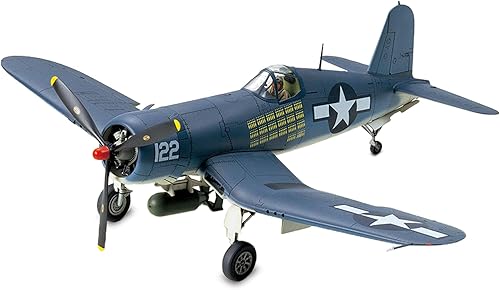
Tamiya F4U-1A Corsair

Tamiya F4U-1D Corsair

Tamiya P-47D Thunderbolt Bubbletop

Tamiya P-47D Thunderbolt Razorback
Beyond single-seat fighters
Once you have a fighter or two finished, twin-engine aircraft and dive bombers are a natural next step.

Tamiya P-38F/G Lightning

Tamiya Mosquito FB Mk.VI

Revell Stuka Ju 87G-1 Tank Buster

Revell SBD Dauntless
Tips for aircraft kits
- Paint the cockpit first. It gets sealed inside the fuselage halves early in the build.
- Add nose weight if the instructions say so. Tricycle-gear aircraft will sit on their tails without it.
- Mask the canopy. Use thin masking tape cut to each frame, or buy pre-cut masks. Glue clear parts with a canopy glue or white glue, not plastic cement, which can fog the plastic.
- Leave the propeller, landing gear and antennas for last. They are the parts most likely to break while you handle the model.
New to all this? Start with our first model kit guide. Prefer to fly one? See RC warbirds for beginners.
Painting WWII fighters
Aircraft camouflage looks complicated, but each air force used a handful of standard colors, and themed paint sets cover them well:
- US Army Air Forces: olive drab over neutral grey early on, then natural bare metal from 1944. A silver P-51D is a classic look; metallic paints go on best over gloss black primer.
- US Navy and Marines: a three-tone blue scheme or glossy dark sea blue later in the war, as on most Corsairs.
- RAF: dark green and dark earth on top with sky or light grey underneath in 1940, later grey and green.
- Luftwaffe: greys with mottling on the fuselage sides, and yellow theater markings on the nose and wingtips.
- Japanese Navy: light grey early (as on the Pearl Harbor Zeros), dark green over grey later.
A gloss coat before decals, then a satin or matt coat afterwards, is the single biggest step toward a finished look. A panel line wash brings out the engraved detail on the wings and fuselage.
If you only build one
For most people, the P-51D Mustang in 1/48 is the right first aircraft. It is a famous subject, the kit is straightforward, and you can finish it in bare metal, olive drab or the colorful nose markings of many fighter groups. If you prefer the RAF, choose the Spitfire Mk.I; for the Pacific, the Zero.
Want something you can build without paint? Brick-built aircraft from COBI capture the shapes well and need no glue at all. See the block set guide.
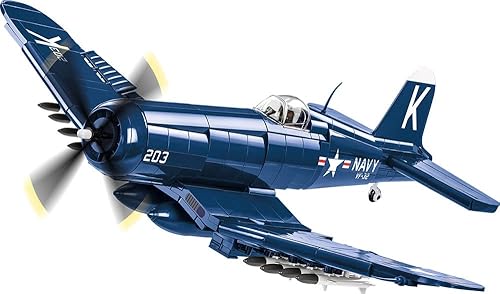
COBI Korean War F4U-4 Corsair, 520 Pieces

COBI Mitsubishi A6M2 Zero

COBI Hawker Hurricane (No. 302 Sqn RAF)
Go deeper:
Quick answers
Which is easier, 1/48 or 1/72?
1/48 is usually easier: the parts are bigger and easier to handle, and decals are less fiddly. 1/72 is cheaper and smaller but needs more care with small parts.
Do aircraft kits include a pilot figure?
Many do, but some do not. Check the listing photos of the parts. Pilots are usually seated and fit inside the cockpit.
Can I build an aircraft with the landing gear up?
Some kits include parts for a wheels-up, in-flight display, often with a stand. Others only offer wheels down; you can sometimes trim the gear doors to close them.
Keep reading
 Aircraft
P-51 Mustang: P-51B vs P-51D vs F-51D and the Kits to Build
How to tell a P-51B from a P-51D and a Korean War F-51D, which markings fit each, and which Mustang kits, block sets and RC planes show which…
Read guide Aircraft
Spitfire Marks Explained: Mk I, II, V, VIII and IX Model Kits
The Spitfire marks explained: how to spot a Mk I, II, V, VIII and IX, the correct RAF camouflage for each period, and which Spitfire kits depict each…
Read guide Aircraft
Zero vs Corsair: Pacific Air War Versions and Model Kits
The A6M Zero Model 21, 32, 22 and 52 and the F4U Corsair -1A, -1D and -4 explained: how to spot each, correct paint and markings, and kits for every…
Read guide