Home › Guides › Bismarck: History & Kits
Battleship Bismarck: History, Camouflage and the Best Model Kits
BuildAnArmy is reader-supported. When you buy through our Amazon links we may earn a commission, at no extra cost to you. How this works.
Bismarck was in service for less than a year. She made one war cruise, which lasted eight days, and she is still one of the most modeled warships ever built. This guide covers what the ship was, what happened in May 1941, how she looked at each stage, and which kit or block set fits the version you want to build.
The ship in brief
Bismarck was launched at Hamburg in February 1939 and commissioned in August 1940. She was the first of two ships in her class. Her sister, Tirpitz, spent most of the war in Norway. Bismarck was about 251 meters long and displaced around 50,000 tonnes fully loaded. She and Tirpitz were the largest battleships Germany ever completed.
- Main guns: eight 38 cm (15-inch) guns in four twin turrets. The Germans named them Anton and Bruno forward, Caesar and Dora aft. Kit instructions often use these names.
- Secondary guns: twelve 15 cm guns in six twin turrets, three on each side.
- Anti-aircraft guns: sixteen 10.5 cm guns in eight twin mounts, plus 3.7 cm and 2 cm light flak.
- Aircraft: Arado Ar 196 floatplanes, launched from a catapult that crossed the deck amidships.
- Machinery: three propellers and twin rudders. Keep the rudders in mind; they decided her fate.
Operation Rheinübung: eight days in May 1941
Germany sent Bismarck and the heavy cruiser Prinz Eugen into the Atlantic to attack Allied convoys. The operation was called Rheinübung (Rhine Exercise). The fleet commander was Admiral Günther Lütjens, and Bismarck's captain was Ernst Lindemann.
The ships left Gotenhafen (today Gdynia, Poland) on 18 to 19 May 1941 and stopped in a fjord near Bergen, Norway. British reconnaissance spotted them there. They then headed north to break out through the Denmark Strait, between Greenland and Iceland.
On 24 May, in the Battle of the Denmark Strait, they met the battlecruiser HMS Hood and the new battleship HMS Prince of Wales. Within minutes Hood blew up and sank. Only three of her crew of more than 1,400 survived. Prince of Wales was damaged and pulled back. Bismarck was hit too. One shell holed her bow and contaminated fuel, so Lütjens turned for occupied France to repair. Prinz Eugen was detached to continue alone.
The Royal Navy lost contact for a time, then found Bismarck again by air. On the evening of 26 May, Swordfish torpedo biplanes from the carrier Ark Royal attacked. A torpedo struck the stern and jammed both rudders. Bismarck could only steam in a wide circle, back toward the pursuing fleet. On the morning of 27 May, the battleships King George V and Rodney shelled her into a wreck, cruisers fired torpedoes, and her crew set scuttling charges. She sank in the North Atlantic. Of more than 2,000 men aboard, only about a hundred were rescued. Robert Ballard's expedition found the wreck in 1989.
Tip: Bismarck's story makes a natural three-ship display. Hood, Prince of Wales and Prinz Eugen are all available as kits, and building them in the same scale shows how much larger Bismarck was than the ship she sank.

Trumpeter HMS Hood Battlecruiser, 1941
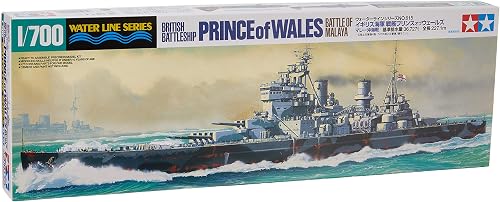
Tamiya HMS Prince of Wales

Tamiya Heavy Cruiser Prinz Eugen

Revell Arado Ar 196A-3 Seaplane
Camouflage: Baltic stripes or Atlantic grey?
This is the first decision for any Bismarck model, because she wore two very different looks within a few weeks.
The Baltic scheme. During her trials and exercises in the Baltic in early 1941, Bismarck carried bold black-and-white stripes near the bow and stern. They ran across the hull sides and up onto the superstructure. The idea was to confuse an observer's judgment of the ship's length, course and speed. She also had a false bow wave painted at the bow. She still wore this scheme when she sailed from Gotenhafen.
The Rheinübung scheme. During the stop near Bergen on 21 May, the crew painted over the stripes and, by most accounts, the false bow wave. In the Denmark Strait and the final battle she was in plain greys. Photos taken from Prinz Eugen during the breakout show this cleaner look.
| Period | What to paint | Good for |
|---|---|---|
| Trials and Baltic exercises, early 1941 to 21 May | Grey ship with black-and-white stripes fore and aft, false bow wave | A striking, colorful display. Most kits include this option. |
| Breakout and final battle, 21 to 27 May 1941 | Stripes painted out, overall greys | A model of the ship that sank Hood and fought her last action |
| Both | Dark red anti-fouling below the waterline, black boot topping, wooden deck | Full-hull models |
Some details are still argued over. Turret-top colors and the air recognition markings on the fore and aft decks changed during 1941, and researchers do not fully agree on what she carried on each date. If you want a specific day, pick one well-documented reference and follow it. Many kits also leave out the deck recognition markings because of laws in some countries.
How to paint the stripes cleanly
- Paint the stripe areas white first, over a light grey primer. White covers poorly over dark colors.
- Mask the white bands with thin tape. Use the kit's painting guide to measure their widths and positions.
- Paint the black bands, then remove the tape slowly while the paint is still slightly soft.
- Remember that the stripes run onto the superstructure. Dry-fit the decks so the bands line up.
How big is a Bismarck in each scale?
| Scale | Model length | What it suits |
|---|---|---|
| 1/1200 | About 21 cm | Quick builds, gifts, wargaming fleets |
| 1/800 | About 31 cm | An older, less common scale (Academy's Tirpitz) |
| 1/700 | About 36 cm | Detailed but compact. The standard collecting scale. |
| 1/350 | About 72 cm | A centerpiece. Needs a deep shelf or a display case. |
The kits, scale by scale
1/1200: small and quick
Revell's 1/1200 range is a good way in. The ship is small enough to finish in a weekend, and it still shows the shape and layout well. The "All-Included" version adds what you need to finish it, according to its name; check the listing for the exact contents.

Revell Battleship Bismarck All-Included Set
Revell's 1/1200 Bismarck in the All-Included format. A small, approachable model for a first ship or a gift, and it sits nicely next to Revell's other 1/1200 warships such as Gneisenau and Duke of York.
Check price on Amazon1/700: the collector's scale
In 1/700 you have three choices. Revell's kit and its gift set, and Trumpeter's kit, which is labeled as the 1941 ship. Trumpeter's ship kits are known for good detail for the price. 1/700 is the right scale if you want to build the whole Rheinübung story, because Hood, Prince of Wales and Prinz Eugen are available in it too.

Trumpeter Bismarck Battleship, 1941
Trumpeter's 1/700 Bismarck is labeled 1941, which is the only year the ship operated. A compact, detailed model that pairs well with Trumpeter's 1/700 HMS Hood for a Denmark Strait display.
Check price on Amazon1/350: the big one
At 1/350 there are two well-known Bismarcks: Tamiya's and Revell's. Tamiya is known for parts that fit without fuss, which matters on a ship this long. Revell's kit is a strong alternative with a good reputation for detail. Either will be a project of many weeks. For the sister ship, Tamiya also makes Tirpitz in 1/350.
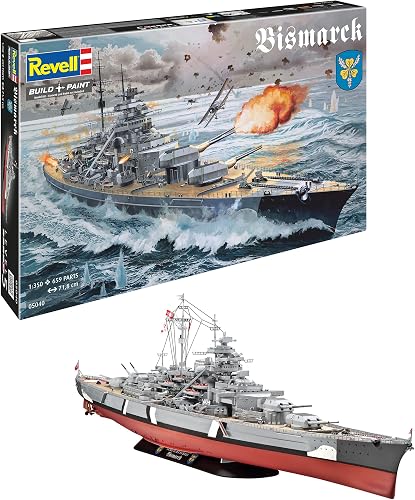
Revell Battleship Bismarck
Revell's 1/350 Bismarck builds into a model over 70 cm long. A good choice if you want lots of detail on a large hull, and a natural companion to Revell's smaller Bismarck kits if you have built one before.
Check price on AmazonBismarck or Tirpitz?
The two sisters look alike, but they are not interchangeable. Tirpitz served in Norwegian fjords from 1942 to 1944, wore several different camouflage schemes there, gained extra anti-aircraft guns, and had deck-mounted torpedo tubes added. A Tirpitz kit is best built as Tirpitz. If you want Bismarck, buy a Bismarck kit.
Block sets and other formats
Bismarck is one of the most popular subjects in brick-built ships. COBI makes a large Bismarck with historical markings, which is typical of the brand's approach. Many other listings share the same piece count, such as 2,081 or 2,535 pieces. That usually suggests a shared design sold under different brand names, so compare listing photos before choosing. Reobrix offers a World of Warships version, and General Jim's sells a 2-in-1 set that builds either Bismarck or Tirpitz. If you do not like bricks, Piececool's metal puzzle is a small desk display.

COBI Battleship Bismarck, 3,204 Pieces
COBI's 3,204-piece Bismarck. COBI focuses on accurate historical subjects, and this is a large display model that needs no glue or paint. A great gift for a Bismarck fan who does not build plastic kits.
Check price on Amazon
General Jim's Bismarck & Tirpitz 2-in-1

Reobrix Bismarck Battleship, World of Warships, 3,462 Pieces

Honchoes Bismarck Battleship, 31 in

Piececool Bismarck Battleship
For a wider look at brick brands, see our military block set guide.
Bismarck-specific build pitfalls
- Decide the date first. The stripes change how you paint the hull and superstructure, so choose before you glue anything together.
- Turret alignment. Four main turrets and six secondary turrets have to point in believable directions. Leave them unglued until the end, and pose them toward the same target.
- The deck. The wooden deck is crowded with fittings. Paint the wood color first, then pick out the grey fittings with a fine brush.
- Rudders and propellers. On a full-hull model, glue the twin rudders straight. They are small, but they tell the story of 26 May.
- Antenna wires. A few fine lines between the masts make a big difference. Stretched sprue or fine thread works; add it last.
If this is your first ship, start with our warship kit guide and the scale guide.
Quick answers
Should I paint Bismarck with stripes or without?
Both are correct for different dates. Stripes show her as she looked in the Baltic and when she left port. Plain grey shows her in the Denmark Strait and the final battle on 27 May 1941.
Which Bismarck kit is best for a beginner?
A 1/1200 Revell kit is the gentlest start. If you want more detail, a 1/700 kit is still manageable. Leave the 1/350 kits until you have built a smaller ship.
How long is a 1/350 Bismarck?
About 72 cm, or roughly 28 inches. Plan for a stand and a shelf deep enough to hold it.
Can I build Tirpitz from a Bismarck kit?
Not accurately. Tirpitz had a different anti-aircraft fit, torpedo tubes and different camouflage. Dedicated Tirpitz kits are available in 1/700 and 1/350.
Do Bismarck block sets need glue?
No. Brick-built Bismarcks snap together and need no paint. Some large sets are long, so measure your shelf first.
Keep reading
 Warships
The Best Warship Model Kits: Battleships, Carriers and Destroyers
The best warship model kits for every level: Bismarck, Yamato, USS Enterprise, Fletcher-class destroyers and more in 1/350 and 1/700, plus…
Read guide Warships
Yamato vs. Iowa Class: The Last Battleships and Their Kits
Yamato and the Iowa class compared, how USS Missouri changed from 1945 to the 1991 Gulf War refit, and which kit or block set to buy for each ship…
Read guide Warships
USS Enterprise and Hornet: Carrier History and Model Kits
USS Enterprise CV-6, USS Hornet CV-8 and the nuclear Enterprise CVN-65: the Doolittle Raid, Midway, carrier kits in every scale and what building one…
Read guide