Home › Guides › Best WWII Tank Kits for Beginners
The Best WWII Tank Model Kits for Beginners
BuildAnArmy is reader-supported. When you buy through our Amazon links we may earn a commission, at no extra cost to you. How this works.
Tanks are one of the best places to start in scale modeling. The shapes are simple, the parts are chunky enough to handle, and a tank looks great even with basic painting and a little mud. The hardest part is choosing, because there are thousands of kits. These are the ones we point beginners to first.
What makes a good first tank kit
- A modest part count. Somewhere around 150 to 250 parts is plenty for a first build. Kits with 800 parts and individual track links are rewarding later, not now.
- Good engineering. Parts that line up without filling and sanding. This is where Tamiya has built its reputation: their 1/35 military kits are known for fitting together with very little fuss.
- Simple tracks. One-piece vinyl or "link and length" tracks are much easier than individual links.
- A subject you care about. Motivation matters more than anything. Build the tank you have watched in documentaries.
Our picks

Tamiya Tiger I Early Production
The Tiger I is the most famous tank of the war, and Tamiya's 1/35 early production version is a classic for a reason: a sensible part count, straightforward instructions and a shape that looks right straight out of the box. Paint it in dark yellow with a simple camouflage, add some mud, and it looks the part.
Check price on Amazon
Tamiya Panther Ausf.A
Many historians rate the Panther as the best all-round German tank design of the war, and this Ausf.A kit captures its sloped armor well. It is slightly more involved than the Tiger I but still a very approachable build.
Check price on Amazon
Tamiya M4 Sherman Early Production
The M4 Sherman was built in huge numbers and served on every front. This early production Sherman is a clean, satisfying build and a great canvas for practicing olive drab, decals and weathering.
Check price on Amazon
Tamiya M5A1 Stuart Light Tank
A light tank means fewer parts and a quicker finish, which is exactly what you want for a confidence-building first project. The M5A1 Stuart is compact, detailed and quick to paint.
Check price on Amazon
Tamiya Panzer IV Ausf.G Early Production
The Panzer IV served from the first day of the war to the last. This Ausf.G early production kit is a modern Tamiya tooling with crisp detail, and it pairs nicely with a Tiger or Panther if you start building a collection.
Check price on AmazonMore strong choices from the same range:

Tamiya JS-2 Heavy Tank
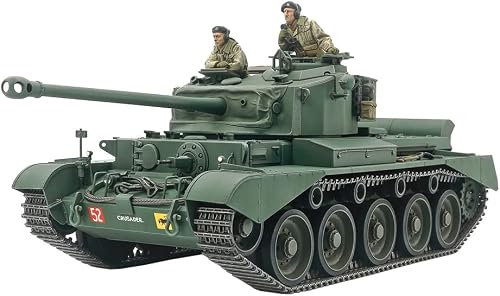
Tamiya Comet A34 Cruiser Tank

Tamiya Churchill Mk.VII

Tamiya M26 Pershing

Tamiya M18 Hellcat Tank Destroyer
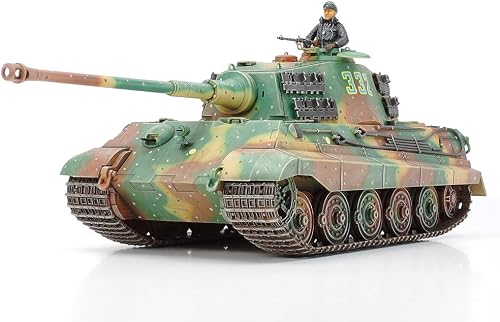
Tamiya King Tiger Production Turret
1/35 or 1/48?
1/35 is the most popular scale for military vehicles. A 1/35 Tiger I is roughly 24 cm long: big enough to show detail, small enough for a shelf. Almost every figure set, diorama accessory and aftermarket part is made in 1/35.
1/48 tanks are smaller and quicker to build, and they sit nicely next to 1/48 aircraft. Tamiya's 1/48 military range often uses a die-cast lower hull, which gives the model a satisfying weight.

Tamiya M4A3E8 Sherman Easy Eight

Tamiya Tiger I Late Production

Tamiya Sherman IC Firefly

Tamiya Churchill Mk.VII
Not sure what the numbers mean? Read our scale guide.
A word about tracks
Track type has a big effect on difficulty. Vinyl band tracks are a single flexible piece; you glue or staple the ends and stretch them over the wheels. They are easiest. Link-and-length tracks come as long straight runs plus individual links for the curves around the sprockets; they look more realistic and take a little patience. Individual link tracks can mean hundreds of tiny parts and are best saved for later builds. The kits above use the simpler options.
Tip: Paint the tracks and the road wheels before you fit the tracks. Getting a brush behind the wheels afterwards is frustrating.
Prefer no glue at all?
If you want the satisfaction of building a tank without cement and paint, brick-built sets are a different but very popular hobby. They snap together and are fully colored out of the box. Read our block set guide, or look at these:

Nifeliz Panzer IV Ausf.G Tank

Nifeliz King Tiger Tank

Nifeliz T-34/85 Tank

Reobrix M4A3E8 Sherman Tank
And if you would rather drive one than build one, our RC tank guide covers the ready-to-run options.
What else you will need
Plastic kits need cement, a sprue cutter, a hobby knife and paint. Our first model kit guide explains exactly what to buy. For WWII German vehicles, a dark yellow and red-brown and green set covers most schemes; Allied vehicles mostly need olive drab or khaki.

Tamiya Extra Thin Cement, 40 ml

Tamiya Sharp Pointed Side Cutter

Vallejo WWII German Infantry Paint Set

Vallejo Model Air WWII Allied Colors, 16 Bottles
Painting WWII tanks: the basic schemes
You do not need dozens of colors for WWII armor. Most vehicles used one of a few schemes:
- German, early war (1939 to 1942): overall dark grey (Panzer Grey). Simple and forgiving.
- German, from 1943: a dark yellow base, often with red-brown and olive green camouflage stripes or patches. You can brush the camouflage in soft-edged bands; it does not need to be perfect, because real crews applied it by hand with whatever tools they had.
- German, North Africa: sand yellow or brown over grey. Tamiya's Afrika Korps kits come with the right markings.
- American: olive drab, often faded and dusty. Add white stars and unit markings from the decal sheet.
- British: varied by theater: khaki green in Europe, sand or "Caunter" desert schemes in North Africa.
- Soviet: a dark green known as 4BO, sometimes with winter whitewash that you can recreate with thinned white paint rubbed partly away.
Once the base colors are dry, a dark wash in the recesses, a little dry-brushing on raised edges and some pigment dust on the lower hull will make even a simply painted tank look convincing.
Choosing by story
A model means more when you know what the vehicle did. A few suggestions to match the kits above:
- Tiger I: famous for its thick armor and 88 mm gun, and for the small number built compared with Allied tanks. Pair it with a German crew figure set for a simple vignette.
- Sherman: the most widely used Western Allied tank, and it evolved through dozens of versions. Building an early and a late Sherman side by side shows how much tanks changed in three years.
- T-34: the Soviet design that shocked German forces in 1941 with its sloped armor and wide tracks. The JS-2 heavy tank above is its bigger successor.
- Panther: designed in response to the T-34, and a good kit to compare with it.
Go deeper:
Quick answers
What is the easiest WWII tank kit?
A Tamiya 1/35 or 1/48 kit of a smaller tank, such as the M5A1 Stuart or Panzer II, is among the easiest. The Tiger I and Sherman kits above are also very approachable.
Do tank kits come with figures?
Many Tamiya tank kits include one or two crew figures, but not all. Check the box art and listing photos. Separate figure sets let you add more crew and infantry.
Can I motorize a plastic tank kit?
Some older Tamiya kits were designed with optional motors, but most modern kits are display models. If you want a tank that moves, look at the RC tanks in our catalog instead.
How big is a 1/35 tank?
Most WWII tanks are 15 to 25 cm long in 1/35. A Tiger I is about 24 cm; a Stuart about 13 cm.
Keep reading
 Tanks
Tiger I: History, Production Versions and the Best Model Kits
How to tell an early, mid and late Tiger I apart, which Tamiya, Revell and block set kits show each version, plus the Tiger II, scale choice and…
Read guide Tanks
M4 Sherman Variants Explained: Which Kit Is Which
M4, M4A1 or M4A3? 75 mm or 76 mm? Learn to identify Sherman variants, from the Easy Eight and British Firefly to Israeli Super Shermans, and the kit…
Read guide Tanks
T-34 vs Panther: Eastern Front Rivals and Their Model Kits
T-34/76 or T-34-85? Panther Ausf. D, A or G? How to identify each version of the Eastern Front rivals, plus the Jagdpanther, and the right kit for…
Read guide