Home › Guides › Die-Cast Metal Kits Explained
Die-Cast and Metal Build Kits Explained: Guns, Cannons and More
BuildAnArmy is reader-supported. When you buy through our Amazon links we may earn a commission, at no extra cost to you. How this works.
A die-cast build kit is a model made mostly of metal parts that you put together yourself. Most need no glue and no paint, and the finished piece has a real weight in the hand. The catalog has two very different families: modern miniature firearm kits from Goat Guns and Massimo Precision, and traditional artillery kits from Guns of History and Model Expo. This guide explains what each one involves, how long it takes, how to display it, and how to gift it responsibly.
What "die-cast" actually means
Die-cast parts are made by forcing molten metal into steel molds, called dies, under pressure. The metal is usually a zinc-based alloy. It captures crisp detail and comes out of the mold close to its final shape. Plastic kits are made in a similar way, but with plastic, which is why the two types can look alike in photos and feel completely different on the desk.
Some kits in this family are not strictly die-cast. Model Expo's Parrott rifle is cast in Britannia metal, a soft, pewter-like alloy that is easy to file and drill. Massimo Precision calls its products metal build kits. For a buyer, the key point is the same: you are building in metal, not plastic, and that changes the tools, the build and the finish.
Every weapon model in this family is a non-firing display model. There is no barrel bore, no firing mechanism and nothing that launches a projectile. Moving parts, where a model has them, are there for display and for the fun of building.
The two families in the catalog
Miniature firearm kits: Goat Guns and Massimo Precision
Goat Guns makes small-scale metal firearm models, mostly at 1/3, 1/4 or 1/2.5 scale. Rifles are built at 1/3 or 1/4, so a full-size rifle becomes a desk piece roughly 25 to 35 cm long. Pistols are usually 1/2.5, which makes a 1911 a palm-sized model under 10 cm long. The range covers WWII classics like the Thompson M1A1, the M1 Garand, the StG 44 and the 1911, Cold War designs like the AK-47, RPK, SVD Dragunov and RPG, and modern rifles like the SIG Sauer MCX, FN SCAR and several Barrett models. There is even a Revolutionary War musket.
Massimo Precision works at larger scales. The catalog lists M1911 kits at 1/1.6 and 1/2, an AKM at 1/1.67 and a Desert Eagle at 1/2. At 1/1.6, a model is a little over 60 percent of the real size, so it reads as a substantial object rather than a miniature. Check each listing for the build method, parts and finish.

Goat Guns Thompson M1A1, Die-Cast Build Kit
The Thompson M1A1 was the simplified wartime version of the famous submachine gun, and it is instantly recognizable. At 1/3 scale it makes a compact desk piece, and it pairs naturally with the 1911 and M1 Garand kits for a small WWII American display.
Check price on Amazon
Massimo Precision M1911 Pistol, Metal Build Kit
Massimo Precision's 1/1.6 M1911 is one of the largest-scale metal kits in the catalog. Choose it if you want a weightier, more detailed object than a 1/2.5 miniature. Read the listing to see exactly what is in the box and how it goes together.
Check price on AmazonArtillery kits: Guns of History and Model Expo
The cannon kits are a different kind of hobby. They are traditional craft kits of famous American artillery pieces, built at 1/16 or 1/24 scale. Guns of History is the artillery line associated with Model Expo and Model Shipways, and the Gatling gun carries the kit number MS4010. These kits take longer, usually need glue and finishing, and reward patience.
Each subject has a real history worth knowing:
- Napoleon 12-pounder. A bronze smoothbore gun-howitzer, the Model 1857, named after the French emperor Napoleon III. It was the most common field gun of the American Civil War, used by both sides.
- 3-inch Ordnance Rifle. A rifled field gun made of wrought iron. It earned a reputation for accuracy and reliability and was used widely by Union artillery.
- 10-pounder Parrott rifle. Designed by Robert Parrott. It was a cast-iron gun with a wrought-iron band shrunk around the breech for strength. That band is the detail that makes a Parrott easy to identify.
- Gatling gun. Richard Gatling patented his hand-cranked, multi-barrel gun in 1862. It saw only limited use in the Civil War, and the US Army adopted it in 1866.

Guns of History Napoleon 12-Pounder Cannon
The Napoleon is the cannon most people picture when they think of the Civil War. At 1/16 it is a good size for a shelf or desk, and it makes a satisfying first artillery kit before you try a more complex subject like the Gatling gun.
Check price on Amazon
Guns of History Civil War Gatling Gun, Metal Kit

Guns of History 3-Inch Ordnance Rifle Field Cannon

Model Expo 10-lb Parrott Rifle Cannon, Britannia Metal
What is in the box
A miniature firearm kit typically contains pre-finished metal parts, small screws and pins, and an instruction sheet. Many Goat Guns models have working parts such as a moving bolt or a removable magazine. The parts arrive already colored or plated, so there is nothing to paint. Goat Guns designs its kits to be built with small tools, and the listings show what is packed with each one. Massimo Precision listings are the best guide to their contents.
A cannon kit looks more like a classic model kit. Expect cast metal parts that may need cleanup, plus materials for the carriage and fittings. Depending on the kit, that can include wood, brass or other metals. Read the listing to see the materials, and assume you will supply glue and finishing products unless it says otherwise.
Tools you need
For a Goat Guns kit, you usually need nothing beyond what comes with it. A few extras make life easier: a tray or bowl to stop tiny screws rolling away, a pair of tweezers for pins and springs, and a soft cloth to work on so the finish does not get scratched.
A cannon kit needs a proper workbench setup:
- Needle files and sanding sticks to remove casting lines and small blobs of metal from cast parts.
- A hobby knife for trimming wood parts and scraping metal edges.
- Superglue (CA) or two-part epoxy for metal. Plastic cement does not work on metal, and that catches out many plastic-kit builders.
- Wood glue if the carriage is wood.
- Primer and paint, or a metal blackening product, for the barrel and ironwork. A black primer is a good base for iron and gunmetal finishes.
- Tweezers and a small drill for fittings, if the instructions call for opening up holes.
Our guide to building your first model kit covers the basic tools in more depth.
How long a build takes
A Goat Guns miniature is a single-sitting project. Most go together in about an hour, so it is a good evening activity rather than a long-term project. Larger metal kits with more parts take longer, and you should allow time to read the instructions carefully, because screws and pins are easy to put in the wrong hole.
A cannon kit is a different commitment. Cleaning cast parts, letting glue cure and painting in coats spreads the work over several evenings or a few weekends. The Gatling gun, with its cluster of barrels and crank mechanism, is the most involved of the artillery kits in the catalog.
Finish options
Because miniature firearm kits come pre-finished, the finish is a choice you make when you buy, not when you paint. The Goat Guns range offers several looks, and the catalog names tell you which one you are getting.
| Finish | Examples in the catalog | Look and appeal |
|---|---|---|
| Black | Sniper Rifle, Bullpup Rifle | Closest to a modern service finish |
| Metal with wood | 1911 Black and Wood, 1911 Silver and Wood, RPG with Real Wood | Classic, warm look that suits WWII and Cold War subjects |
| Gold | AK-47 Gold Edition, Barrett M82A1 Gold | Decorative, trophy-style display piece |
| Tan, grey or camo | AR-15 Tan, SIG Sauer MCX Grey, SR L9A1 Camo | Modern military and desert tones |
| Themed editions | AR-15 USA Flag, 1911 USA Edition, M17 Thin Blue Line, 1911 Soft Light Blue | Commemorative or personal gifts |
| Skeletonized | Skeletonized AR-15 | Cut-away styling that shows the internal shapes |
Cannon kits give you full control. You can paint a Napoleon's barrel in a bronze tone, which is how the real guns looked when new, or in the dull brown-green that old bronze takes on. Iron guns like the Parrott and the 3-inch rifle look right in dark grey or black. Union carriages are usually shown in an olive green.

Goat Guns AK-47, Gold Edition, Die-Cast Build Kit

Goat Guns 1911 Pistol, Silver & Wood, Die-Cast Build Kit

Goat Guns SR L9A1 Sniper, Camo, Die-Cast Build Kit

Goat Guns Skeletonized AR-15, Die-Cast Build Kit
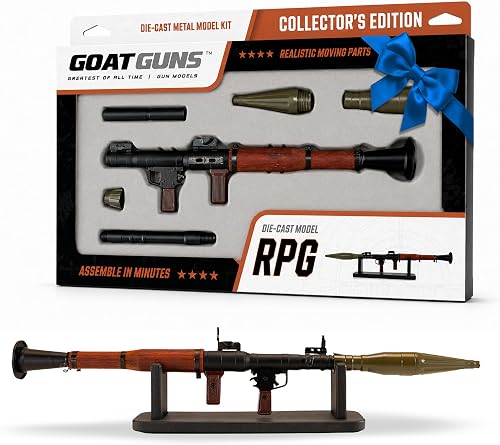
Goat Guns RPG with Real Wood, Die-Cast Build Kit
Displaying your collection
Small metal models look best grouped. A single Goat Guns miniature can get lost on a shelf, but a row of them, arranged by era or nation, tells a story. A WWII American set might include the 1911, the Thompson and the M1 Garand. A Cold War set could put the AK-47, the RPK and the SVD Dragunov side by side.

Goat Guns Model Display Rack, Holds 10 Models
This Goat Guns rack holds up to ten models, according to its name, so a growing collection stays tidy and upright. It turns a handful of loose miniatures into one display, and it suits an office desk or a bookshelf.
Check price on AmazonCannons look best on a small base. A strip of wood with a little painted ground, or a short length of fence, gives the gun context. Our diorama guide shows how to build a simple base. For any metal model, keep it out of damp rooms and dust it with a soft brush rather than a cloth that can snag small parts.
Responsible display and gifting
These are non-firing models, but miniature firearm kits look realistic, and the larger-scale kits look more realistic still. A little common sense keeps them a pleasure rather than a problem:
- Keep them at home or at your desk. Do not carry them in public or point them at anyone. Someone at a distance cannot tell a 1/2 scale pistol from a real one.
- Check workplace and school rules before taking one to an office or classroom. Many have policies about realistic weapon models of any size.
- Pack them in checked luggage when you travel. Airport security in many countries treats realistic replica guns as not allowed in carry-on bags. Check the rules before you fly.
- Mind the small parts. Screws, pins and springs are a choking hazard. Keep kits and finished models away from young children, and follow the age guidance on the listing.
As gifts, these kits are popular with veterans, collectors and anyone who likes history and mechanisms. Match the subject to the person: a WWII veteran's family might choose a Garand or a 1911, and a Civil War reader would enjoy a Napoleon cannon. If the recipient lives with small children, a cannon kit or a sealed display is a more considerate choice. Our gift guide has more ideas.
How metal kits differ from plastic kits
| Die-cast firearm kit | Metal cannon kit | Plastic model kit | |
|---|---|---|---|
| Glue | None | CA, epoxy or wood glue | Plastic cement |
| Paint | None, pre-finished | Usually yes | Usually yes |
| Build time | About an hour | Several evenings | A few evenings to many weeks |
| Customizing | Limited to the finish you buy | Full control | Full control |
| Feel | Heavy, solid | Heavy, solid | Light |
Plastic kits offer far more subjects, more detail and the satisfaction of painting your own scheme. Metal kits trade that for speed, weight and a finished look with no mess. Many builders enjoy both. To see where every type fits, read model kit types compared, and if metal appeals but you want a longer build, try the metal and wood 3D puzzle kits.
Quick answers
Can a die-cast gun model fire?
No. Every weapon model in this family is a non-firing display model. There is no working bore or firing mechanism. Moving bolts and magazines are for display only.
Do I need glue or paint for a Goat Guns kit?
No. The parts come pre-finished and go together with small screws and pins. Cannon kits are different and usually need glue and paint.
How big is a 1/3 scale rifle model?
Roughly a third of the real length, so most rifles end up about 25 to 35 cm long. Pistols at 1/2.5 are under 10 cm.
Are these kits suitable for children?
They contain tiny screws and pins, so they are not for young children. Follow the age guidance on each listing and supervise younger builders.
Which is the best first cannon kit?
The Napoleon 12-pounder is a good start. It is a simple, well-known subject. Save the Gatling gun for when you have a build or two behind you.
Keep reading
 Types
Model Types Compared: Plastic Kits, Block Sets, Die-Cast and RC
Plastic kits, block sets, die-cast, 3D puzzles or RC? Compare build time, tools, skill, detail, durability and display size to pick the right…
Read guide Types
Plastic Model Kit Difficulty: How to Tell How Hard a Kit Is
How hard is that model kit? Learn to judge difficulty from skill ratings, part count, scale, tracks, clear parts, photo-etch, decals and tooling…
Read guide Types
Metal and Wood 3D Puzzle Kits: Piececool, ROKR, UGEARS
How Piececool metal sheet puzzles and laser-cut wood kits from ROKR, UGEARS and others work: tools, rubber-band mechanisms, safety, difficulty and…
Read guide