Home › Guides › Tiger I: History & Kits
Tiger I: History, Production Versions and the Best Model Kits
BuildAnArmy is reader-supported. When you buy through our Amazon links we may earn a commission, at no extra cost to you. How this works.
The Tiger I is probably the most modeled tank in history. It is also one of the easiest to get wrong, because the Tiger changed a lot during its two years of production. A Tiger that fought near Leningrad in 1942 looks quite different from one that fought in Normandy in 1944. This guide explains the history, shows you how to spot each production version, and matches the kits in our catalog to the tank they actually depict.
A short history of the Tiger I
The Tiger I was a German heavy tank designed by Henschel. Its official name was Panzerkampfwagen VI Tiger, first designated Ausf. H and renamed Ausf. E in 1944. That is why some kits, like Revell's 1/72 version, say "Ausf. H" and others say "Ausf. E". They are the same tank.
Production ran from August 1942 to August 1944, and about 1,350 were built. That is a tiny number next to the tens of thousands of Shermans and T-34s, and it explains why Tigers were concentrated in independent heavy tank battalions rather than spread across ordinary panzer divisions.
The Tiger's reputation came from two things. First, its 8.8 cm KwK 36 gun, which could knock out any Allied tank of 1942 and 1943 at long range. Second, its armor: 100 mm on the front of the hull and turret. Its weaknesses were the flip side of the same design. At around 57 tonnes it was heavy on fuel and hard on its running gear, it was slow to build, and recovering a broken-down Tiger was a major job.
Tigers first saw action near Leningrad in September 1942, then in Tunisia from late 1942. In April 1943 British forces in Tunisia captured an intact Tiger, number 131. It is now at The Tank Museum in Bovington, England, and it is the reason "Tiger 131" appears on so many block sets. Tigers then fought at Kursk in July 1943, across the Eastern Front, in Italy and in Normandy in 1944.
Early, Mid and Late: how to tell them apart
The Germans did not use the labels "early", "mid" and "late". Modelers and historians use them to group the many small changes made on the production line. The changes did not all happen on one date, and tanks were often repaired with newer parts, so treat these as guidelines and check photos of the exact tank you want to build.
| Feature | Early (1942 to mid-1943) | Mid (mid-1943 to early 1944) | Late (early 1944 to Aug. 1944) |
|---|---|---|---|
| Commander's cupola | Tall drum shape with vision slits | Lower cast cupola with periscopes | Lower cast cupola with periscopes |
| Road wheels | Rubber-tired, interleaved | Rubber-tired, interleaved | Steel-rimmed wheels with no rubber tires |
| Air filters | Large Feifel filter canisters on the hull rear, piped to the engine deck | Removed | Removed |
| Smoke dischargers | Three on each side of the turret front | Removed | Removed |
| Zimmerit paste | No | Often, from about September 1943 | Usually |
| Gunsight openings in mantlet | Two (binocular sight) | Two | One (monocular sight) on later tanks |
| Kits in our catalog | Tamiya 1/35 35216, Tamiya 1/48 32603 | Tamiya 1/35 35194 | Tamiya 1/48 32575 |
Early production
The quickest way to recognize an early Tiger is the drum-shaped commander's cupola, a tall cylinder with narrow vision slits. Look at the rear of the hull too. Early Tigers carried the Feifel air filter system: two large canisters on the rear plate, connected by pipes to the engine deck. They were meant to keep dust out of the engine, which mattered in Tunisia and on dusty Russian roads. Early tanks also had triple smoke grenade dischargers on each side of the turret front, and the very first tanks had two headlights instead of the later single one.
Early Tigers needed two sets of tracks. The wide combat tracks made the tank too wide for a railway car, so for rail transport crews fitted narrower tracks and removed the outer row of road wheels. Photos of Tigers on trains look odd for this reason, and it is a fun option for a diorama.
Tiger 131 and the other Tunisian tanks are early production vehicles. If you want to build a Tunisian, Leningrad or Kursk Tiger, start with an early production kit.

Tamiya Tiger I Early Production
Tamiya's 1/35 Tiger I Early Production is the natural starting point for a 1942 or early 1943 Tiger: drum cupola, Feifel filters and the early turret fittings. Tamiya kits have a long reputation for clean fit, so it suits a first or second tank kit as well as an experienced builder.
Check price on AmazonMid production
From around July 1943 the Tiger received a new cast commander's cupola with periscopes. It is lower and wider than the drum, and it is the single easiest way to separate an early Tiger from a mid one. Around the same time the Feifel filters and the turret smoke dischargers were deleted, so the hull rear looks much cleaner.
From about September 1943 factories applied Zimmerit, a paste that left a ridged texture on the hull and turret. Its purpose was to stop magnetic mines from sticking to the armor. A mid-production Tiger built in summer 1943 may have no Zimmerit; most built from the autumn have it.
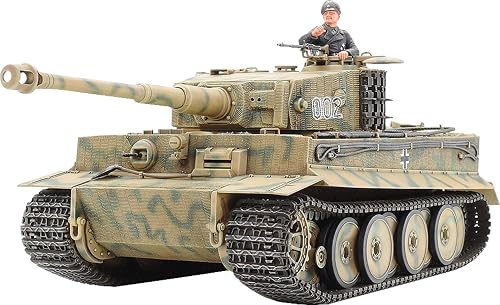
Tamiya Tiger I Mid Production
Tamiya's 1/35 Mid Production kit gives you the cast cupola and the clean hull rear of the Tiger that fought from late 1943. Check the listing photos to see whether Zimmerit is molded on. If it is not, you can build a summer 1943 tank, or add the texture yourself with putty.
Check price on AmazonLate production
From early 1944 Tigers began to receive steel-rimmed road wheels. These have internal rubber cushioning, so there is no rubber tire on the outside. You can spot them in photos by the plain steel rim and the ring of bolts. Field repairs often mixed steel and rubber-tired wheels, so photos sometimes show both on one tank.
Later in 1944 the gunner's binocular sight was replaced by a monocular one, so the gun mantlet has one sight opening instead of two. Late Tigers also have a thicker turret roof with small sockets for a crane, and many carry a close-defense weapon in the turret roof. These are the Tigers of Normandy, Italy and the 1944 battles in the East.

Tamiya Tiger I Late Production
Tamiya's 1/48 Tiger I Late Production shows the steel-wheeled, 1944 Tiger. 1/48 is quicker to build and takes less shelf space than 1/35, and it sits well next to 1/48 aircraft.
Check price on AmazonTip: Before you paint, decide on one real tank and one date. A Tiger with early filters, steel wheels and Normandy markings never existed. Picking a specific vehicle from a photo book or museum makes every detail decision easy.
Dealing with Zimmerit
Zimmerit is the detail that scares most Tiger builders. If your kit does not have it molded on, you have three choices. You can build a tank that did not have it, which covers every early Tiger and the first mid-production tanks. You can buy aftermarket Zimmerit sheets made for your kit. Or you can apply a thin layer of modeling putty and press a ridge pattern into it with a tool. The putty method takes practice, so try it on a spare piece of plastic first. Zimmerit was applied before the factory paint, so it sits under the camouflage and should look like part of the armor, not a separate layer.
The Tiger II (King Tiger) in brief
The Tiger II, often called the King Tiger or Königstiger, was a different tank, not an upgrade of the Tiger I. It had sloped armor like the Panther, 150 mm of armor on the hull front and the longer, more powerful 8.8 cm KwK 43 gun. Fewer than 500 were built, from early 1944 to the end of the war. It first saw combat in the summer of 1944.
There are two turrets to know. The first 50 tanks had the Porsche turret, with a rounded front and a bulge on the left side for the commander's cupola. The curved front could deflect hits down into the thin hull roof, so production switched to the Henschel turret, with a flat, angled front plate. The Henschel turret is far more common and is what most kits show.
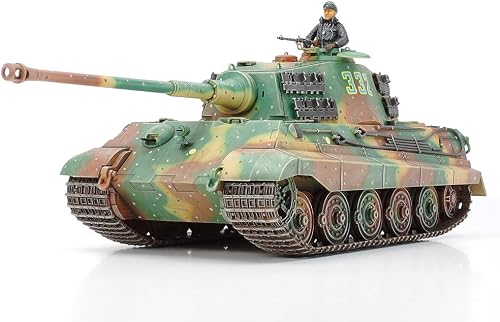
Tamiya King Tiger Production Turret

Tamiya King Tiger, Henschel Turret

Revell Tiger II Ausf.B, Henschel Turret

Revell Tiger II Ausf.B
Tamiya's 1/35 "Production Turret" and 1/48 "Henschel Turret" kits and Revell's 1/35 Henschel turret kit all show the main production version. If you want the Porsche turret in bricks, the Boolakos King Tiger set is labeled with it.
Choosing a scale
- 1/35 is the classic choice. A Tiger I is about 24 cm long including the gun, so there is room for detail and a huge range of figures and accessories. Choose this if you want the most realistic result.
- 1/48 is about 18 cm long and quicker to finish. It is a good choice if you want to build all three production versions side by side without filling a shelf.
- 1/72 is about 12 cm long. Revell's 1/72 Tiger I is good for wargaming or a small collection, but small parts need more care.
Our scale guide explains the numbers in more detail.
Paint schemes by period
- 1942 to early 1943: the first Tigers left the factory in dark grey. Many Tigers in Tunisia were painted in desert colors, so research the specific tank before you choose.
- From 1943: German tanks switched to a dark yellow base color. Crews added camouflage in red-brown and olive green, sprayed or brushed in stripes, blotches or soft patches. Patterns varied from unit to unit.
- Winter on the Eastern Front: a temporary whitewash over the base color, often worn and streaky. You can copy it by brushing thinned white paint and rubbing some away before it dries.
Turret numbers were usually painted on the turret sides, and their style differed by battalion. Use the kit decals or look at photos of the unit you choose. A German paint set covers the main colors; our first model kit guide explains how to prime and paint.
Common build pitfalls
- Interleaved wheels. The Tiger's overlapping road wheels make painting the inner rows hard. Paint the wheels before you fit them, and paint the hull behind them dark first.
- Track sag. Real Tiger tracks sag between the return points on top of the wheels. Vinyl tracks pulled tight look wrong.
- Mixing features. Use the kit's options for one tank only. Kits often include optional parts for several versions.
- Too much weathering. A heavy layer of mud hides the details that make each production version distinctive.
Block sets and RC Tigers
Many block sets show Tiger 131, which means an early production tank. COBI makes Tiger 131 in several sizes, from small sets to large ones of well over a thousand pieces, plus a Tiger I Ausf. E based on the tank at the Musée des Blindés in Saumur, France. Other brands sell Tigers named after specific turret numbers. They are display models rather than scale replicas, but the cupola and wheels still tell you which version the designer had in mind. Read our block set guide for more.
If you want to drive one, a 1/16 Tiger I with proportional control is the realistic option, while a 1/72 mini tank is a desk toy. Our RC tank guide explains the difference.

COBI Panzer VI Tiger I No. 131, 898 Pieces

COBI Tiger I Ausf.E, Musée des Blindés, 870 Pieces

PrecisionX Tiger I Proportional RC Tank

Revell Tiger I Ausf.H
Quick answers
Is the Tiger I Ausf. H the same as the Ausf. E?
Yes. The tank was first designated Ausf. H and renamed Ausf. E in 1944. Kits use both names for the same tank.
Which Tiger I version is Tiger 131?
Tiger 131 is an early production Tiger captured in Tunisia in 1943. An early production kit with the drum cupola is the right base for it.
What is the easiest way to tell an early Tiger from a late one?
Look at the commander's cupola and the wheels. A tall drum cupola means early. Steel-rimmed wheels with no rubber tires mean late.
Do I have to add Zimmerit?
No. Early Tigers and some mid-production Tigers from summer 1943 had none. Only add it if the tank you are building had it.
Is the King Tiger a Tiger I upgrade?
No. The Tiger II was a new design with sloped armor and a longer 8.8 cm gun. It shares the name, not the hull.
Keep reading
 Tanks
The Best WWII Tank Model Kits for Beginners
The WWII tank model kits that build cleanly and look great for a first or second build: Tiger I, Panther, Sherman, T-34 and more, plus what to know…
Read guide Tanks
M4 Sherman Variants Explained: Which Kit Is Which
M4, M4A1 or M4A3? 75 mm or 76 mm? Learn to identify Sherman variants, from the Easy Eight and British Firefly to Israeli Super Shermans, and the kit…
Read guide Tanks
T-34 vs Panther: Eastern Front Rivals and Their Model Kits
T-34/76 or T-34-85? Panther Ausf. D, A or G? How to identify each version of the Eastern Front rivals, plus the Jagdpanther, and the right kit for…
Read guide