Home › Guides › Sherman Variants Explained
M4 Sherman Variants Explained: Which Kit Is Which
BuildAnArmy is reader-supported. When you buy through our Amazon links we may earn a commission, at no extra cost to you. How this works.
The M4 Sherman was built in more versions than almost any other tank. Different engines, hulls, guns and suspensions were combined in dozens of ways, and the British and Israelis added their own variants on top. That variety is great for modelers, because you can build a whole shelf of Shermans that all look different. It also means the name on the box matters. This guide explains what the letters and numbers mean, how to identify each version, and which kit in our catalog shows which Sherman.
Why there were so many Shermans
The United States built roughly 50,000 Shermans between 1942 and 1945, more than any other American tank. To reach that number, the Army had several factories build the tank at once, using whatever engines were available. The result was a family of tanks that shared the same basic layout but differed in hull construction and power plant. The Sherman served with American, British, Commonwealth, Free French, Polish and Soviet forces during the war, and with many armies afterward. Israel kept upgraded Shermans in front-line service into the 1970s.
The Sherman was not the most powerful tank of the war, but it was reliable, easy to maintain, and available in huge numbers. That is a big part of its story, and it is why it pairs so well with a Tiger I or Panther on a display shelf. If this is your first tank kit, start with our beginner tank guide.
M4, M4A1, M4A2, M4A3, M4A4: what the letters mean
The suffix after "M4" tells you the hull type and the engine. It does not tell you the gun or the suspension. Those are added separately, for example "M4A3 (76) W" or "M4A3E8".
| Model | Hull | Engine | British name | How to spot it | Kits in our catalog |
|---|---|---|---|---|---|
| M4 | Welded (late tanks: cast front, welded rear) | Radial gasoline | Sherman I | Flat-sided welded hull with sharp corners | Tamiya 1/35 35190 (early production); Tamiya 1/48 32532 (Firefly IC) |
| M4A1 | Cast, one piece | Radial gasoline | Sherman II | Rounded, smooth hull with no straight edges | Tamiya 1/35 35322 (Israeli M1 Super Sherman); COBI and General Jim's block sets |
| M4A2 | Welded | Twin diesel | Sherman III | Welded hull, different engine deck and exhaust | COBI M4A2E8 block set |
| M4A3 | Welded | Ford V8 gasoline | Sherman IV | Welded hull; the US Army's favorite in 1944 and 1945 | Tamiya 1/35 35250, 35359; Tamiya 1/48 32595; motorized and RC versions |
| M4A4 | Welded, lengthened | Chrysler multi-bank | Sherman V | Longer hull, with wider spacing between the bogies | Most Fireflies (Sherman VC) |
The easiest split is cast versus welded. A cast M4A1 hull looks like a smooth, rounded tub. A welded hull is built from flat plates with sharp edges. Telling a welded M4 from a welded M4A3 takes a closer look at the engine deck and rear plate, so the kit's name is your best guide.
Early and late hulls
Shermans also changed during production. Early tanks had a bolted three-piece transmission cover on the nose, which you can spot by the row of bolts across it. Later tanks used a one-piece cast nose. Early hulls had small driver's hatches set into a steep front plate. Late hulls had a flatter front plate with larger hatches. Late tanks also stored ammunition in water-protected bins to reduce fires, shown by a "W" in names like M4A3 (76) W.

Tamiya M4 Sherman Early Production
Tamiya's M4 Sherman Early Production shows the welded-hull Sherman of 1942 and 1943. It is an ideal kit if you want the classic early look, and it makes a good contrast with a late-war Easy Eight. It suits beginners and is a great canvas for olive drab and weathering practice.
Check price on Amazon75 mm or 76 mm?
Shermans went to war with a 75 mm M3 gun. It was a good general-purpose gun with an effective high-explosive shell, but by 1943 it struggled against the frontal armor of the Panther and Tiger. The answer was the longer 76 mm M1 gun, fitted in a larger turret that had been developed for another tank. 76 mm Shermans entered combat in Normandy in July 1944.
How to tell them apart:
- Barrel: the 75 mm barrel is short and ends just past the front of the hull. The 76 mm barrel is clearly longer, and many have a muzzle brake.
- Turret: the 76 mm turret is bigger, with a long rear bustle. The original 75 mm turret is smaller and rounder.
- Gun mantlet: the 76 mm mantlet is a wider block.
Many 75 mm Shermans kept fighting until the end of the war, often alongside 76 mm tanks in the same unit, so either gun is correct for 1944 and 1945 Europe.
The Easy Eight and HVSS
Early Shermans used VVSS (vertical volute spring suspension): three bogies per side, each with two road wheels and a return roller on top. It worked, but the narrow tracks gave poor flotation in mud and snow.
The fix was HVSS (horizontal volute spring suspension), with paired road wheels and much wider tracks. The test designation for the M4A3 with the 76 mm gun and HVSS was M4A3E8. "E" was "Easy" in the phonetic alphabet of the day, so crews called it the Easy Eight. It reached units in Europe from late 1944 and was a mainstay of American armor in the Korean War.
To spot one, look at the wheels. HVSS road wheels come in pairs, side by side, with the springs mounted horizontally between them. VVSS bogies have tall vertical housings and single wheels.

Tamiya M4A3E8 Sherman Easy Eight, European Theater
Tamiya's M4A3E8 European Theater kit shows the late-war Easy Eight with the 76 mm gun and HVSS. It is a modern Tamiya subject that pairs well with a late Tiger or Panther, and it covers the look of 1945 Germany.
Check price on AmazonWant it smaller? Tamiya also makes the Easy Eight in 1/48 (32595), which is quicker to build and sits well with 1/48 aircraft.
The British Firefly
The British received thousands of Shermans and gave them their own names (see the table above). They added a letter for the gun: "A" for the 76 mm, "B" for the 105 mm howitzer and "C" for the British 17-pounder. A Sherman with a 17-pounder became known as the Firefly. A Sherman VC was a Firefly based on the M4A4, and a Sherman IC was based on the M4. The VC was the most common.
The 17-pounder was the most powerful Allied tank gun in general use in Normandy. Fireflies were usually spread out, one per troop of four tanks, so every troop had one tank that could deal with Tigers and Panthers.
How to spot a Firefly:
- A very long barrel with a muzzle brake, reaching well past the front of the hull.
- An armored box on the back of the turret, added to hold the radio because the gun's breech filled the turret.
- No hull machine gun. The co-driver's position was removed to make room for ammunition, and the machine gun opening was usually plated over.
- Countershading: some crews painted the outer half of the barrel in a light color and the underside dark, so it looked shorter from a distance.

Tamiya Sherman IC Firefly
Tamiya's 1/48 Sherman IC Firefly is the M4-based version with the 17-pounder. It is a compact, satisfying build and an easy way to add a British tank to a Normandy collection. Paint it in British olive drab with British markings, not American stars.
Check price on AmazonIsraeli Super Shermans
Israel collected Shermans from many sources after 1948 and kept upgrading them. The most famous upgrades used French guns:
- M50: a Sherman fitted with a French 75 mm high-velocity gun, the same family as the gun on the AMX-13 light tank. The turret was modified with a counterweight at the rear.
- M51: a Sherman with a shortened French 105 mm gun, a very large muzzle brake and a big counterweight on the turret rear. M51s used HVSS and a diesel engine.
The Israelis also used "M1" for Shermans with the American 76 mm M1 gun, and those with HVSS were known as M1 Super Shermans. Both M50s and M51s fought in the 1967 and 1973 wars.

Tamiya Israeli M51 Super Sherman

Tamiya Israeli M1 Super Sherman

Tamiya M4A3 Sherman 75mm

Tamiya M4A3E8 Sherman Easy Eight
Tamiya makes both an M51 (35323) and an M1 Super Sherman (35322) in 1/35. Check the listing photos for the exact hull and stowage. Israeli tanks of this era are usually painted in a pale grey-sand color often called Sinai Grey, with Israeli unit markings that varied by unit and war, so follow the kit decals or a photo of the tank you choose.
Painting and markings
- US Army: olive drab, faded and dusty. White stars were standard, but many crews painted them out or toned them down in 1944 because they made good aiming points.
- US Marines in the Pacific: olive drab, sometimes with wood planks or other add-on protection on the hull sides.
- British and Commonwealth: olive drab with British unit and tactical markings.
- Korean War Easy Eights: olive drab, and some units painted large tiger faces on the front of the hull.
- Israel: Sinai Grey from the 1960s, plus Israeli markings.
Tip: Olive drab looks too dark at scale if you paint it straight from the bottle. Lighten it slightly with a touch of tan or white for the upper surfaces, then use a dark wash in the recesses. The contrast makes a small model read much better on the shelf.
Common build pitfalls
- Mixing gun and turret. A 76 mm gun needs the larger turret. Check the instructions if the kit offers both.
- Wrong suspension for the date. HVSS on a Normandy tank in June 1944 is wrong. VVSS on a Korean War Easy Eight is wrong.
- American markings on a Firefly. Fireflies were British and Commonwealth tanks.
- Stowage overload. Real Shermans often carried a lot of gear, but piling it on hides the hull features that tell you which version you built.
Block sets and RC Shermans
Sherman block sets also follow the variants. COBI's M4A1 sets have the rounded cast hull, while its M4A3 set and the Easy Eight sets from Reobrix, MISINI and others have the welded hull and HVSS. COBI's Sherman M4A3E2 Jumbo shows the heavily armored assault version, of which only a few hundred were built. The block set world is a nice way to build a cast and a welded Sherman side by side. See our block set guide for brand differences.
If you want a Sherman that moves, Tamiya makes a 1/35 M4A3 motorized kit and an M4A3 RC kit with a control unit, which combine model building with driving. A 1/16 Heng Long M4A3 is a larger hobby-grade option; our RC tank guide compares the types.

COBI Sherman M4A1 Tank, 615 Pieces

COBI M4A3 Sherman Tank
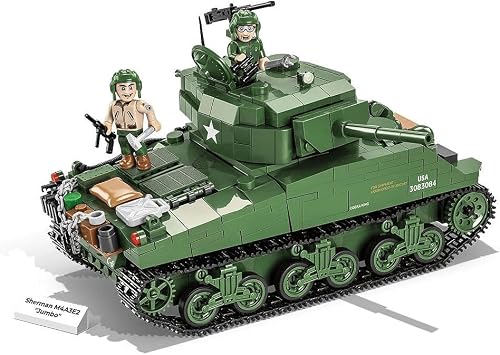
COBI Sherman M4A3E2 Jumbo, 720 Pieces

Tamiya M4A3 Sherman RC Kit with Control Unit

BESTYMXY Heng Long M4A3 Sherman
Quick answers
What is the difference between an M4 and an M4A1 Sherman?
The hull. The M4 has a welded hull made of flat plates; the M4A1 has a rounded one-piece cast hull. Both used a radial gasoline engine.
Why is it called the Easy Eight?
Its test designation was M4A3E8, and "E" was spoken as "Easy" in the phonetic alphabet of the time.
Was the Firefly an American tank?
No. It was a British conversion of American-built Shermans, armed with the British 17-pounder gun.
Which Sherman kit is best for a beginner?
Tamiya's 1/35 M4 Sherman Early Production or the M4A3 75 mm are straightforward builds. The 1/48 Easy Eight is a good smaller option.
What is a Super Sherman?
A name used for upgraded Israeli Shermans, especially the M50 with a French 75 mm gun and the M51 with a French 105 mm gun. The IDF also used "M1 Super Sherman" for 76 mm Shermans with HVSS.
Keep reading
 Tanks
The Best WWII Tank Model Kits for Beginners
The WWII tank model kits that build cleanly and look great for a first or second build: Tiger I, Panther, Sherman, T-34 and more, plus what to know…
Read guide Tanks
Tiger I: History, Production Versions and the Best Model Kits
How to tell an early, mid and late Tiger I apart, which Tamiya, Revell and block set kits show each version, plus the Tiger II, scale choice and…
Read guide Tanks
T-34 vs Panther: Eastern Front Rivals and Their Model Kits
T-34/76 or T-34-85? Panther Ausf. D, A or G? How to identify each version of the Eastern Front rivals, plus the Jagdpanther, and the right kit for…
Read guide