Home › Guides › T-34 vs Panther: History & Kits
T-34 vs Panther: Eastern Front Rivals and Their Model Kits
BuildAnArmy is reader-supported. When you buy through our Amazon links we may earn a commission, at no extra cost to you. How this works.
The T-34 and the Panther are tied together by history. The Soviet T-34 shocked the German army in 1941, and the Panther was Germany's direct answer to it. The T-34 then grew a bigger gun to answer the Panther. Building the two side by side tells that story on your shelf. This guide explains the main versions of each tank, how to tell them apart, and which kits in our catalog show which version.
How the rivalry started
When Germany invaded the Soviet Union in June 1941, its tank crews met the T-34 in numbers for the first time. The T-34 combined three ideas that were rare in one tank at the time: sloped armor that deflected shots, a powerful 76.2 mm gun, and wide tracks that coped with mud and snow. It was also designed to be built quickly and in very large numbers. More than 80,000 T-34s of all versions were built, making it one of the most produced tanks in history.
The German response was the Panzerkampfwagen V Panther, designed by MAN. It borrowed the T-34's sloped armor and wide tracks and added a long, high-velocity 7.5 cm KwK 42 gun with excellent accuracy and armor penetration. About 6,000 Panthers were built. It first saw combat at Kursk in July 1943, where many broke down with mechanical problems. Once those problems were reduced, the Panther became one of the most respected tanks of the war.
The two tanks reflect two approaches. The T-34 was simple, rugged and produced in huge numbers. The Panther was more complex, with better optics and a better gun, but it took longer to build and was harder to keep running. Neither approach was simply "better", and that is part of why the matchup is still debated.
T-34/76 versions
"T-34/76" is a Western label for the T-34 with the 76.2 mm gun. Soviet records just called it the T-34. Names like "Model 1940", "Model 1942" and "Model 1943" are also partly labels used by historians and modelers. Several factories built T-34s at the same time, each with its own details, so two tanks from the same year can look different.
Model 1940
The first production T-34s had the short L-11 76.2 mm gun with a distinctive recoil housing below the barrel, and a small turret with one large hatch that covered most of the turret roof. A Model 1940 is the T-34 of the 1941 battles.

Revell T-34/76 Model 1940
Revell's 1/35 T-34/76 Model 1940 shows the first production version with the early gun and the big single turret hatch. It is a good choice if you want the tank that surprised the German army in 1941. Revell kits are widely available and are a solid choice for a 1/35 Soviet subject.
Check price on AmazonModel 1941 and 1942
The longer F-34 gun replaced the L-11 in 1941, and that is the gun most T-34/76s carry. Turrets were cast or welded depending on the factory, and simplified parts appeared as wartime production was sped up.
Model 1943
From 1942 a new hexagonal turret appeared, roomier than the first, with two round hatches on the roof. When both are open they look like ears, which earned it the nickname "Mickey Mouse" from German troops. A commander's cupola was added on later tanks. This is the T-34/76 of Kursk and the big 1943 battles.
The T-34-85
By 1943 the 76.2 mm gun had trouble against the frontal armor of the Tiger and Panther. The answer was the T-34-85, with a much larger turret and an 85 mm gun. It entered combat in early 1944 and became the main Soviet medium tank for the rest of the war. It stayed in service with many armies for decades and was used by North Korea in the Korean War.
The bigger turret also solved a serious problem. In the T-34/76 the commander also had to aim and fire the gun, which made it hard to watch the battlefield. The T-34-85 turret held three men, so the commander could focus on commanding.
| Version | Gun | How to spot it | Kits in our catalog |
|---|---|---|---|
| T-34 Model 1940 | 76.2 mm L-11 | Short gun with recoil housing underneath, one big turret hatch | Revell 1/35 03294 |
| T-34 Model 1943 | 76.2 mm F-34 | Hexagonal turret with two round roof hatches | Tamiya 1/35 35059; COBI 1/72 and brick-built sets |
| T-34-85 | 85 mm | Large three-man turret, much longer gun, commander's cupola | Tamiya 1/48 32599; Revell 1/72 03302; COBI, Nifeliz and Honchoes block sets; Heng Long 1/16 RC |

Tamiya T-34-85
Tamiya's 1/48 T-34-85 is a modern kit of the late-war version. 1/48 keeps it compact and quick to build, and it makes a well-matched pair with Tamiya's 1/48 Panther kits.
Check price on AmazonTamiya's 1/35 T-34/76 1943 covers the hexagonal-turret version. Check the listing photos for the turret details.
Panther Ausf. D, A and G
The Panther's versions came in an odd order: the Ausf. D came first in 1943, then the Ausf. A from late summer 1943, then the Ausf. G from 1944. Each step is easy to spot once you know where to look.
| Feature | Ausf. D (1943) | Ausf. A (late 1943 to 1944) | Ausf. G (1944 to 1945) |
|---|---|---|---|
| Commander's cupola | Drum shape with vision slits | Cast cupola with periscopes | Cast cupola with periscopes |
| Hull machine gun | Fired through a flap ("letterbox") in the front plate | Ball mount | Ball mount |
| Driver's vision port | In the front plate | In the front plate | Removed; front plate is clean |
| Hull sides | Original design | Original design | Redesigned, with a single sloped upper side plate |
| Zimmerit | Late tanks | Common | Until about September 1944 |
| Kits in our catalog | Tamiya 1/35 35345, Tamiya 1/48 32597 | Tamiya 1/35 35065, COBI block set | Tamiya 1/35 35170 (early), 35176 (late), 30055 (motorized); Tamiya 1/48 32520 |
Ausf. D
The first Panthers, the ones that fought at Kursk. Look for the drum-shaped cupola, the same idea as on the early Tiger I, and the hull machine gun firing through a small flap in the front plate instead of a ball mount. Early tanks also carried smoke grenade dischargers on the turret sides.

Tamiya Panther Ausf.D
Tamiya's 1/35 Panther Ausf. D is the Kursk-era Panther, with the drum cupola and the letterbox machine gun flap. It is a modern Tamiya tooling and the right kit if you want to build the Panther and T-34 as they met in 1943.
Check price on AmazonAusf. A
The Ausf. A introduced the cast cupola with periscopes and a proper ball mount for the hull machine gun. The driver's vision port stayed in the front plate. Many Ausf. A Panthers carry Zimmerit. This version fought on the Eastern Front, in Italy and in Normandy.
Ausf. G
The Ausf. G was the most produced Panther. It had a redesigned hull with sloped one-piece upper side plates, and the driver's vision port was deleted, leaving a clean front plate. Later Ausf. Gs often have a "chin" mantlet, with a flat lip at the bottom of the gun shield. It was added to stop shots from deflecting down into the thin hull roof. Tamiya's Early and Late Ausf. G kits let you build either side of that change, but check photos, because many late tanks kept the earlier mantlet.
A famous Ausf. G is "Pudel", one of the Panthers captured and used by Polish Home Army fighters during the 1944 Warsaw Uprising. COBI and Reobrix both make block sets of it.
The Jagdpanther
The Jagdpanther was a tank destroyer built on the Panther chassis. It carried the long 8.8 cm Pak 43 gun in a fixed, sloped superstructure, giving it the firepower of the King Tiger on a lighter, faster vehicle. Only about 400 were built from 1944. Early Jagdpanthers had a small collar around the gun mount. Later ones had a larger bolted collar, which is the easiest way to tell them apart. Tamiya's "Late Version" kits in 1/35 and 1/48 show the later type.

Tamiya Jagdpanther Late Version

Tamiya Jagdpanther Late Version
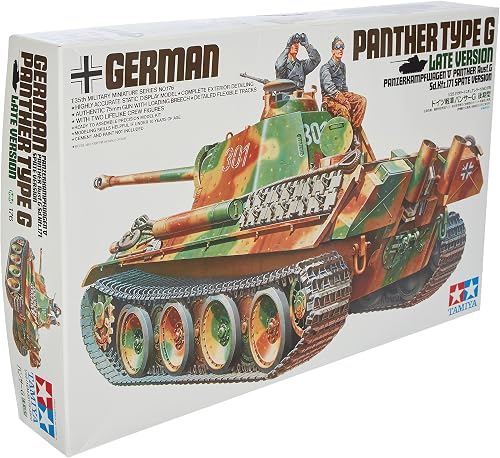
Tamiya Panther Ausf.G Late Version

Tamiya Panther Ausf.G Early Version
Paint schemes
- T-34: a dark green known as 4BO. In winter, a white wash was brushed over it and quickly wore off. Many T-34s carried patriotic slogans in Russian on the turret sides, and turret numbers in white. Postwar T-34-85s wear the colors of many armies, which gives you a lot of choice.
- Panther: the dark yellow base introduced in 1943, with red-brown and olive green camouflage. Kursk Panthers often had simple patterns or a plain base coat. Late-war Panthers had more varied schemes.
Tip: If you build a T-34 and a Panther as a pair, choose the same year and season. A green summer 1943 T-34/76 next to a Kursk-era Panther Ausf. D works well. A T-34-85 fits with a Panther Ausf. G from 1944 or 1945.
Common build pitfalls
- Mixing Panther features. A drum cupola with a ball-mounted machine gun is wrong for a standard tank. Use the table above.
- Factory differences on T-34s. Do not assume every detail in a photo applies to your kit. Pick one photo of one tank.
- Overdoing the whitewash. Real winter camouflage was thin and patchy. Several thin coats look better than one thick one.
- Big road wheels. Both tanks have large road wheels. Paint and weather them before you fit the tracks.
Block sets and RC versions
Block set makers have covered both tanks. COBI makes a T-34/76 Model 1942 set, several T-34-85 sizes, and Panthers in Ausf. A and Ausf. G form. Some sets are simply called "Panther" with a turret number, so look at the cupola and hull front in the photos to see which version the designer chose. Watch out for the Panther II: it never went into production, so a Panther II set is a "what if" design. Our block set guide compares the brands.
For RC, the 1/16 Heng Long T-34-85 is a hobby-grade option; see our RC tank guide. Tamiya's motorized Panther Ausf. G is a plastic kit that also drives.

COBI T-34/76 Mod. 1942 2-in-1, 852 Pieces

COBI T-34-85, 286 Pieces

COBI Panther Ausf.A (Sd.Kfz.171), 1,157 Pieces

COBI Panther Ausf.G "Pudel", 1,133 Pieces

BESTYMXY Heng Long T-34/85
Quick answers
Was the Panther a copy of the T-34?
No, but it was designed in response to it. It borrowed ideas like sloped armor and wide tracks and combined them with a German gun, optics and engineering.
What is the difference between a T-34/76 and a T-34-85?
The T-34-85 has a much larger three-man turret and an 85 mm gun. The T-34/76 has a smaller turret with a 76.2 mm gun, and its commander also had to work the gun.
Why did the Panther Ausf. D come before the Ausf. A?
The letters were not assigned in order. The Ausf. D was the first production version, followed by the Ausf. A and then the Ausf. G.
How can I tell a Panther Ausf. A from an Ausf. G?
Look at the front plate. The Ausf. A has a driver's vision port in it. The Ausf. G has a clean front plate with no port.
Which scale should I choose for a T-34 and Panther pair?
1/48 is an easy match, because Tamiya makes the T-34-85 and several Panthers in that scale. In 1/35 you can pair Revell's or Tamiya's T-34/76 with Tamiya's Panther Ausf. D.
Keep reading
 Tanks
The Best WWII Tank Model Kits for Beginners
The WWII tank model kits that build cleanly and look great for a first or second build: Tiger I, Panther, Sherman, T-34 and more, plus what to know…
Read guide Tanks
Tiger I: History, Production Versions and the Best Model Kits
How to tell an early, mid and late Tiger I apart, which Tamiya, Revell and block set kits show each version, plus the Tiger II, scale choice and…
Read guide Tanks
M4 Sherman Variants Explained: Which Kit Is Which
M4, M4A1 or M4A3? 75 mm or 76 mm? Learn to identify Sherman variants, from the Easy Eight and British Firefly to Israeli Super Shermans, and the kit…
Read guide