Home › Guides › RC Military Models Explained
RC Military Models Explained: Tanks, Planes, Helicopters, Ships
BuildAnArmy is reader-supported. When you buy through our Amazon links we may earn a commission, at no extra cost to you. How this works.
An RC model is the only kind of military model that moves under your control. That is the appeal, and it is also why RC asks more of you than a kit on a shelf: batteries, chargers, radio gear, wear and tear, and for aircraft, real rules about where you fly. This guide covers what applies to every RC tank, plane, helicopter and ship, so you know what you are buying and what you need beside it.
For specific models, see our picks in the best RC military tanks and RC warbirds for beginners. This guide is the background that makes those choices easier. If you are still deciding between RC and a kit you build, start with model kit types compared.
Toy-grade vs hobby-grade
Every RC military model falls somewhere on a line between a toy and a hobby machine. The labels are not official, but the differences are real.
- Toy-grade models are sold complete and ready to use. They often have simple on/off controls (full speed or stopped), a built-in or proprietary battery, and a remote that only works with that one model. When a part breaks, there is usually no spare to buy. They are the easiest and usually the cheapest way in, and they are a fine choice for kids and casual fun.
- Hobby-grade models use replaceable parts, standard connectors and proportional controls, so speed and steering follow how far you move the stick. You can repair them, buy spares and upgrade them. They cost more up front and need more care, but a well-maintained hobby-grade model can last for years.
Military RC tanks show this split clearly. Small infrared battle tanks and most 1/24 tanks are toy-grade. The 1/16 tanks built on the Heng Long platform sit at the entry level of hobby-grade, with a large spare-parts and upgrade market. Tamiya also sells RC tanks you assemble like a plastic kit, which is a different experience again.

Tamiya M4A3 Sherman RC Kit with Control Unit
A 1/35 Tamiya M4A3 Sherman that you assemble like a plastic kit, with a control unit according to the listing name. It suits a modeler who wants to build and paint the tank and then drive it. Check the listing for which batteries you need.
Check price on AmazonWhat is in the box, and what is not
RC listings use a few standard terms, mostly from the aircraft world. Learn them and you will avoid the most common surprise: a model that cannot run on day one.
| Term | What it means | What you still need |
|---|---|---|
| RTR / RTF (ready to run / fly) | Model, transmitter and usually a battery and charger | Often AA batteries for the transmitter |
| BNF (bind-n-fly) | Model with a receiver installed | A compatible transmitter, battery and charger |
| PNP (plug-n-play) | Model with motor, speed controller and servos | Transmitter, receiver, battery and charger |
| ARF (almost ready to fly) | Mostly built airframe | Most or all of the electronics |
| Kit | Parts you build, often balsa for aircraft | Glue, covering and electronics unless listed |
Toy-grade tanks and boats almost always come complete, though many need AA batteries for the remote. Hobby models vary, so read the "in the box" section and check the listing photos. A PNP jet such as the Amewi MB-339 in our catalog is aimed at someone who already owns a radio.
Tip: Buy a second battery with any RC model. Run times are short, and a spare doubles your time between charges. Make sure the spare matches the original voltage, connector and size.
Batteries: NiMH vs LiPo
Most RC military models run on one of two rechargeable chemistries. Some toys use small lithium-ion packs that charge over USB, which behave much like LiPo for safety purposes.
NiMH (nickel-metal hydride)
NiMH packs are built from 1.2-volt cells, so a six-cell pack is 7.2 volts. They are heavy for the power they hold, but they are tough and forgiving. They tolerate being run flat and do not need special storage care. They are still common in older and simpler RC tanks.
LiPo (lithium polymer)
LiPo packs hold much more power for their weight, which is why nearly all RC aircraft and most modern hobby models use them. Each cell is 3.7 volts nominal and 4.2 volts when full. Packs are described by cell count ("2S" means two cells in series, 7.4 volts), capacity in mAh, and a discharge "C" rating.
LiPo packs demand respect. Treat these rules as non-negotiable:
- Charge with a LiPo balance charger, set to the correct chemistry and cell count, and plug in the balance lead.
- Never leave a charging LiPo unattended, and never charge overnight. Charge on a non-flammable surface, ideally inside a LiPo safety bag or a metal box.
- Do not over-discharge. Running a LiPo below roughly 3 volts per cell damages it. Most hobby speed controllers cut power before that point; land or stop when the model slows.
- Let the pack cool after a run before you charge it.
- Retire puffed or damaged packs. A swollen, dented or punctured LiPo should not be charged or used again. Take it to a battery recycling point.
- Store at storage charge, about 3.8 volts per cell, if you will not use the pack for more than a few days. Most hobby chargers have a storage mode. Never store LiPos fully charged for weeks, and keep them in a cool, dry place.
Chargers
Toy-grade models usually ship with a basic USB or wall charger. Use the one that came with the model and unplug it when charging is done. Hobby-grade models often include a simple charger or none at all. A multi-chemistry hobby charger handles NiMH and LiPo, balance charges and has a storage mode, which makes it a smart buy once you own more than one model. Always select the right chemistry: charging a LiPo on a NiMH setting is dangerous. Also check the connector; common types include JST, Tamiya, T-plug, XT30 and XT60.
Transmitters and 2.4 GHz
Nearly every current RC model uses a 2.4 GHz radio. The transmitter and receiver "bind" to each other and hop across frequencies, so many models can run side by side without interference.
Ground models such as tanks and trucks usually come with a pistol-grip or two-stick handset. Aircraft use two-stick transmitters. In the United States, "Mode 2" (throttle on the left stick) is the usual layout. Hobby receivers only work with transmitters that use the same radio protocol, so if you plan to buy BNF or PNP models later, choose a transmitter brand with a wide range of compatible receivers. Toy-grade remotes are paired to one model and cannot be reused.
One physical limit to know: 2.4 GHz signals do not pass through water. A model submarine that dives too deep loses contact, which is why toy submarines are made for shallow water such as pools and tubs.
Infrared battle tanks vs BB-firing tanks
RC tanks "fire" in one of two ways, and the difference matters for safety.
- Infrared (IR) battle tanks fire an invisible light beam. A sensor on the other tank counts hits, with lights and sound, until one tank is knocked out. Nothing leaves the barrel, so IR is safe indoors and ideal for kids and family battles. Check that both tanks use compatible IR systems, which is easiest if they come from the same maker.
- BB-firing tanks shoot small plastic pellets, usually 6 mm airsoft-style BBs, and some toys use soft gel beads. Even at low power, a BB can injure an eye. Everyone nearby, not only the driver, should wear safety glasses. Never aim at people, pets or windows, follow the age rating on the box, and pick up spent BBs afterward, because they are a choking hazard for small children and pets.

HobbyToki Heng Long Leopard 2A6 BB + IR, Hobby-Grade
A 1/16 Heng Long Leopard 2A6 that the listing describes as having both BB and IR firing. It lets you battle indoors with infrared and save BBs for outdoor target practice with eye protection. A good way to see both systems on one hobby-grade platform.
Check price on Amazon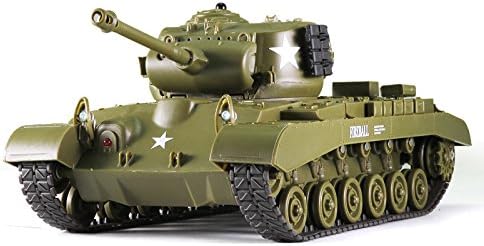
Heng Long M26 Pershing Infrared Battle Tank

Liated Tiger I Infrared Mini Tank

Supdex Metal M1A2 Abrams, Shoots BBs

PrecisionX Tiger I Proportional RC Tank
Where you can run each type
| Type | Good places | Avoid |
|---|---|---|
| Mini IR tanks | Floors, tables, desks | Thick carpet, outdoors |
| 1/24 to 1/16 tanks and trucks | Hard floors, patios, packed dirt, short grass | Sand, water, wet grass, public sidewalks with people |
| Ships and submarines | Pools, calm ponds where model boats are allowed | Swimmers, weeds, moving water, deep water for subs |
| Small coaxial helicopters | Indoors, large rooms | Wind, outdoors |
| Planes, larger helicopters | Large open fields, club flying sites | People, roads, trees, power lines, airports |
Sand is the enemy of tracked models: it gets into tracks, sprockets and gearboxes. For boats, check park rules before you launch, plan how you will recover a stalled model without wading in, and rinse anything used in salt water. RC flying clubs are worth finding, since they have safe fields and experienced members who can help with first flights.

Ssccgym Battleship, 60 cm
A 60 cm Ssccgym battleship in 1/390 scale. It is a large enough hull to handle a calm pond and looks the part on the water. Open it up and let the inside dry after each run.
Check price on AmazonUS rules for recreational flyers
In the United States, the FAA treats RC planes and helicopters as unmanned aircraft, the same category as drones. Recreational flyers fly under the FAA's exception for limited recreational operations. In general terms, that means:
- Pass the TRUST. The Recreational UAS Safety Test is a short, free online test. Every recreational flyer needs to pass it and carry proof, whatever the model weighs.
- Register models over 250 grams (0.55 lb), with the battery installed, and mark the registration number on the outside. Registered aircraft also need to meet the Remote ID rule, unless flown at an FAA-recognized identification area such as many club fields.
- Keep it in sight and give way to manned aircraft.
- Stay at or below 400 feet in uncontrolled airspace, and get authorization before flying in controlled airspace near airports. The FAA's B4UFLY tool shows what applies where you are.
- Follow a community-based organization's safety guidelines, such as those of a national model aviation club.
Many foam warbirds weigh more than 250 grams, while some micro models weigh less; check the listed flying weight. Rules change, so confirm the current details on the FAA website before you fly. Outside the US, check your national aviation authority.

WLtoys K170 UH-60 Black Hawk Helicopter
A WLtoys K170 UH-60 Black Hawk in the park-flyer class. It is a recognizable military subject for someone who has outgrown small indoor helicopters. Check its listed weight to see whether it needs FAA registration.
Check price on AmazonMaintenance and spare parts
A few minutes after each session prevents most breakdowns:
- Tanks: brush dirt from tracks and wheels, check track tension, and listen for gearbox noises. A grinding sound usually means debris or a worn gear.
- Aircraft: check the propeller for nicks, make sure control linkages are tight, and repair foam cracks with a foam-safe glue. Ordinary CA glue can melt some foams.
- Boats: dry the hull, check seals and remove weeds from the propeller.
- All models: check screws, wires and battery connectors, and unplug the battery for storage.
Spares are where hobby-grade models earn their cost. Propellers, landing gear, track links, road wheels, gearboxes and control boards are all sold separately for popular platforms. Before you buy, search for spare parts by the model's name. If none exist, treat it as a toy.
Upgrades
Hobby-grade tanks have the deepest upgrade path. Metal gearboxes and metal tracks add durability and weight, which improves traction. Newer control boards add features; Heng Long boards come in numbered generations, and several listings in our catalog name theirs, such as V7. Many owners also repaint and weather their tanks, using the same methods as in painting a model tank and weathering for beginners. For aircraft, the most useful upgrade is usually a better transmitter. Watch weight and balance: a heavier battery moves the center of gravity and changes how a plane flies.

HobbyToki Humvee 4x4 Crawler, Hobby-Grade

Skymaker Willys Military Truck 4x4 Crawler

Tipmant Mini Military Submarine

PrecisionX LHD Amphibious Assault Ship
Browse them all on our RC models page.
Quick answers
Do RC models come with batteries?
Ready-to-run models usually include the main battery and a charger, but many need AA batteries for the transmitter. BNF, PNP and ARF models usually need you to supply some or all of the electronics. Check the listing.
Are LiPo batteries dangerous?
They are safe when handled correctly, but a damaged, over-discharged or overcharged LiPo can catch fire. Use a proper charger, never charge unattended, and retire any pack that swells.
Can two RC tanks run at the same time?
Yes, if both use 2.4 GHz radios, which almost all current models do. For IR battles, both tanks need compatible infrared systems.
Do I need to register an RC plane with the FAA?
In the US, recreational models over 250 grams must be registered, and every recreational flyer must pass the free TRUST test. Check the FAA website for current rules.
Is a BB-firing tank safe for kids?
Follow the age rating on the box, and require safety glasses for everyone nearby. For younger children, an infrared battle tank is the safer choice.
Keep reading
 Types
Model Types Compared: Plastic Kits, Block Sets, Die-Cast and RC
Plastic kits, block sets, die-cast, 3D puzzles or RC? Compare build time, tools, skill, detail, durability and display size to pick the right…
Read guide Types
Plastic Model Kit Difficulty: How to Tell How Hard a Kit Is
How hard is that model kit? Learn to judge difficulty from skill ratings, part count, scale, tracks, clear parts, photo-etch, decals and tooling…
Read guide Types
Die-Cast and Metal Build Kits Explained: Guns, Cannons and More
What die-cast and metal build kits are: Goat Guns miniatures, Massimo Precision, Civil War cannon kits, tools, build time, finishes, display and safe…
Read guide