Home › Guides › Yamato vs Iowa: History & Kits
Yamato vs. Iowa Class: The Last Battleships and Their Kits
BuildAnArmy is reader-supported. When you buy through our Amazon links we may earn a commission, at no extra cost to you. How this works.
Yamato and the Iowa class were the last battleships designed by the two largest navies of the Pacific War. They answered the same problem in opposite ways. Japan built the biggest guns and armor possible, in a few huge ships. The United States built faster ships that could keep up with its carriers. This guide compares them, explains how USS Missouri changed between 1945 and 1991, and sorts out which kit shows which ship at which date.
The two designs compared
| Yamato | Iowa class | |
|---|---|---|
| Length | About 263 m | About 270 m |
| Full-load displacement | About 72,000 tonnes | About 57,000 tonnes in WWII |
| Main guns | Nine 46 cm (18.1-inch) in three triple turrets | Nine 16-inch in three triple turrets |
| Top speed | About 27 knots | About 33 knots |
| Ships completed | Yamato and Musashi (a third, Shinano, became a carrier) | Iowa, New Jersey, Missouri, Wisconsin |
| Fate | Both sunk by US carrier aircraft, 1944 and 1945 | All four survive as museum ships |
The Iowas were longer but much lighter. Their extra length went into a slim hull and powerful machinery for speed. Yamato was shorter and very wide, with the heaviest guns ever mounted on a battleship. On a shelf, the difference is obvious: Yamato looks broad and massive, while an Iowa looks long and lean.
Yamato: the secret giant
Yamato was built at Kure in great secrecy and commissioned in December 1941, just after Pearl Harbor. She spent much of the war as a fleet flagship, held back for a decisive battle that never came. At Leyte Gulf in October 1944 she fired her main guns at American ships off Samar. Her sister Musashi was sunk by air attack during the same battle.
In April 1945 Yamato sailed toward Okinawa on a one-way mission called Ten-Go. US carrier aircraft caught her at sea on 7 April and sank her with bombs and torpedoes. Most of her crew of more than 3,000 were lost.
How Yamato changed: spot the version
- As completed (1941 to 1943): four triple 15.5 cm secondary turrets, one forward and one aft on the centerline, plus one on each side amidships. Relatively few light anti-aircraft guns.
- Late war (1944 to 1945): the two side 15.5 cm turrets were removed and replaced with extra 12.7 cm anti-aircraft guns. The decks filled up with triple 25 mm anti-aircraft mounts, well over a hundred barrels by 1945.
Most Yamato kits are designed around her late-war appearance, which is the most popular look. If you want the earlier, cleaner ship, check the box art and instructions for the side secondary turrets before buying.
Painting Yamato
Japanese warships were painted grey, but the exact shade varied by the navy yard that built or maintained the ship. Yamato was built at Kure, so modelers usually paint her in a color sold as Kure arsenal grey. The main deck was largely bare wood, which looks pale and slightly yellow when new, so a light wood tone works better than a dark brown. Below the waterline, use a red anti-fouling color on full-hull models. A small gold imperial chrysanthemum crest sat on the bow, and it is a tiny detail worth picking out with a fine brush. Go easy on weathering. On a big battleship, light streaking and a soft wash in the recesses usually look more convincing than heavy rust.
The Iowa class: fast battleships
USS Iowa was commissioned in February 1943. Her three sisters followed, with Missouri, the last US battleship ever completed, commissioned in June 1944. The Iowas escorted the fast carrier task forces across the Pacific, screening them with heavy anti-aircraft fire and bombarding islands. On 2 September 1945, the Japanese surrender was signed on Missouri's deck in Tokyo Bay.
The Iowas served again in Korea and, in New Jersey's case, Vietnam. In the 1980s all four were modernized and recommissioned. Missouri and Wisconsin fought in the 1991 Gulf War, firing Tomahawk missiles and 16-inch shells. Today Missouri is a museum at Pearl Harbor, close to the USS Arizona memorial. That is where the Pacific War began and, in a sense, ended.
USS Missouri in 1945 vs. 1991
This is the most important thing to understand before you buy an Iowa-class kit. The same ship looked very different 46 years apart, and kits depict one or the other.
| Feature | 1945 | 1991 |
|---|---|---|
| Paint | Measure 22: navy blue lower hull band, haze gray above | Overall haze gray |
| Main deck | Wood stained deck blue | Largely bare teak |
| 5-inch guns | Ten twin mounts | Six twin mounts |
| Light anti-aircraft | Dozens of 40 mm quad and 20 mm guns | Removed. Four Phalanx close-in weapon systems added. |
| Missiles | None | Armored box launchers for Tomahawks and canisters for Harpoons |
| Aircraft | Floatplanes on two stern catapults | Helicopter landing area on the fantail |
| Masts and sensors | WWII radars | Modern radars and electronic warfare antennas |
The quickest way to identify a kit's era from the box art: look amidships. Square armored missile boxes and white Phalanx domes mean the 1980s or 1991. Rows of quad 40 mm gun tubs along the decks mean WWII.
Painting Measure 22
Measure 22 is simple but has one rule. The navy blue band runs straight and level from bow to stern, up to the height of the lowest point of the main deck. It does not follow the curve of the deck. Mask a level line from the waterline up, and the rest of the ship is haze gray. Use a darker blue for the WWII decks. For 1991, use haze gray overall, a wood color for the teak, and a dark gray for non-skid areas.
Which kit for which ship
Read the product name closely. Where a year is in the name, it tells you the configuration. Where there is no year, check the box art for the clues above.
| Ship | 1/700 | 1/350 | Other scales |
|---|---|---|---|
| Yamato | Tamiya 31113; Fujimi Next Series | Tamiya 78030 | MISINI block set (stated 1/300) |
| Musashi | Tamiya 31114 | - | - |
| Iowa | Tamiya 31616; Trumpeter (1984) | Hobby Boss 86517 | - |
| New Jersey | Tamiya 31614; Trumpeter (1983) | Tamiya 78028 | Revell 1/1200 gift set |
| Missouri | Trumpeter (1991); Academy (multi-color parts) | Tamiya 78029 (1991); Hobby Boss 86516 | Academy 1/400; Lindberg 1/600; Revell 1/535 |
| Wisconsin | Trumpeter (1991) | - | - |
A few notes on scales. A 1/700 Yamato or Iowa is about 38 cm long, and a 1/350 one about 75 to 77 cm. Academy's 1/400 Missouri is about 68 cm. Odd scales such as 1/535 and 1/600 usually mean an older kit designed to fit a standard box. They build into a fine display, but expect less detail than a modern 1/700 kit.
Can you build one Iowa sister from another sister's kit? In principle, yes, but the four ships differed in small details at different dates, such as bridge shapes, radars and gun fits. A kit marked for one ship is best built as that ship unless you research the changes.
Top picks

Tamiya Battleship Yamato
Tamiya's 1/350 Yamato makes a model about 75 cm long of the largest battleship ever built. Tamiya's engineering keeps a big, crowded ship manageable, and the late-war anti-aircraft fit gives you a dramatic, busy deck.
Check price on Amazon
Tamiya USS Missouri BB-63, 1991
Tamiya's 1/350 Missouri depicts the ship in 1991, during the Gulf War. Build it with the missile launchers and Phalanx mounts that the WWII ship never had, then display it next to a WWII Iowa to show the change.
Check price on Amazon
Tamiya USS Iowa BB-61
Tamiya's 1/700 USS Iowa is a good way to start the class. It is a manageable size, and at 1/700 you can build a Yamato next to it for a direct comparison on one shelf.
Check price on Amazon
Tamiya Battleship Yamato

Fujimi IJN Battleship Yamato, Next Series

Hobby Boss USS Missouri BB-63 Battleship

Trumpeter USS Missouri BB-63 Battleship, 1991
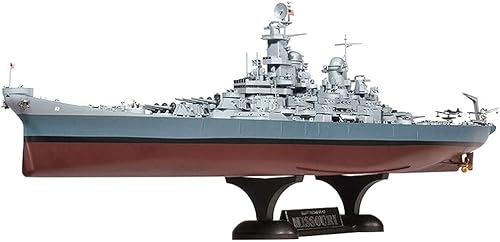
Academy USS Missouri BB-63 Battleship
Block sets
Missouri is one of the most common subjects in brick-built ships, and Yamato has a large MISINI set with a stated scale of 1/300. That would put it close to 90 cm long. Many Missouri listings share a 2,228-piece count, which usually points to one design sold under several names. General Jim's offers a larger Deluxe Edition, and Bricknite and Duant offer USS Iowa. As with kits, check the photos: missile boxes and Phalanx domes mean the modern ship.

MISINI Battleship Yamato, 2569 Pieces

MISINI USS Missouri Battleship, 2228 Pieces

General Jim's USS Missouri Battleship, Deluxe Edition, 2,631 Pieces

Bricknite USS Iowa (BB-61) Battleship, 2,198 Pieces
Build pitfalls for the last battleships
- Anti-aircraft clutter. Late-war Yamato and WWII Iowas carry huge numbers of tiny guns. Paint them on the sprue, then glue them in groups. Good tweezers are essential.
- The Measure 22 line. A wavy line ruins the effect. Measure from the waterline at several points before masking.
- Mixing eras. Some kits include parts for more than one date. Decide your year and follow only those steps.
- Long hulls. Ships over 70 cm long can twist slightly. Dry-fit the decks to the hull and glue in sections.
For general ship advice and painting basics, see our warship kit guide. For another famous battleship, read our Bismarck guide.
Quick answers
Was Yamato bigger than USS Missouri?
Yamato was heavier and wider, with bigger guns. Missouri was slightly longer. At full load Yamato displaced around 72,000 tonnes against roughly 57,000 for an Iowa in WWII.
Did Yamato and an Iowa ever fight each other?
No. Yamato was sunk by carrier aircraft in April 1945. The two designs never met in a gun battle.
Which Missouri kit shows the surrender ship of 1945?
Look for a kit with quad 40 mm guns and no missile launchers. Kits labeled 1991, such as Tamiya's 1/350 and Trumpeter's 1/700, show the modernized ship.
What paint does a 1945 Iowa-class battleship need?
For Measure 22: navy blue for the lower hull band, haze gray for everything above it, a deck blue for the decks, and a red anti-fouling color below the waterline on full-hull models.
Is 1/700 or 1/350 better for these ships?
1/700 if you want both ships side by side on a normal shelf. 1/350 if you want one showpiece and you enjoy fine detail work.
Keep reading
 Warships
The Best Warship Model Kits: Battleships, Carriers and Destroyers
The best warship model kits for every level: Bismarck, Yamato, USS Enterprise, Fletcher-class destroyers and more in 1/350 and 1/700, plus…
Read guide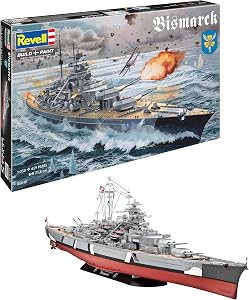 Warships
Battleship Bismarck: History, Camouflage and the Best Model Kits
Bismarck's story, her 1941 fit, Baltic stripes vs. the grey she wore in the Atlantic, and the best Bismarck kits and block sets from 1/1200 to…
Read guide Warships
USS Enterprise and Hornet: Carrier History and Model Kits
USS Enterprise CV-6, USS Hornet CV-8 and the nuclear Enterprise CVN-65: the Doolittle Raid, Midway, carrier kits in every scale and what building one…
Read guide