Home › Guides › Carriers: Enterprise & Hornet
USS Enterprise and Hornet: Carrier History and Model Kits
BuildAnArmy is reader-supported. When you buy through our Amazon links we may earn a commission, at no extra cost to you. How this works.
In the six months after Pearl Harbor, a handful of American carriers held the line in the Pacific. Two of them, USS Enterprise and USS Hornet, took part in both the Doolittle Raid and the Battle of Midway. This guide covers their history, the very different nuclear-powered Enterprise that followed, the kits for each, and what to expect when you build a carrier.
The Yorktown class
Enterprise (CV-6) and Hornet (CV-8) were sisters of USS Yorktown (CV-5). Yorktown and Enterprise were commissioned in 1937 and 1938. Hornet was a later order on the same basic design and joined the fleet in October 1941, weeks before the US entered the war. Each ship was about 250 meters long and could operate around 90 aircraft.
Of the three, only Enterprise survived the war. Yorktown was lost at Midway in June 1942. Hornet was sunk at the Battle of the Santa Cruz Islands in October 1942. Enterprise fought through almost every major carrier battle of the Pacific War and earned 20 battle stars, more than any other US ship in WWII. Despite efforts to preserve her, she was scrapped in the late 1950s.
The Doolittle Raid, April 1942
In early 1942 the US wanted to strike Japan itself. Navy carrier aircraft did not have the range, so Lieutenant Colonel James Doolittle led a plan to fly Army B-25 Mitchell bombers off a carrier. Sixteen B-25s were loaded onto Hornet's flight deck. They were too large to go below, so Hornet's own aircraft were struck down into the hangar, and she could not fight while carrying the bombers. Enterprise sailed with her to provide air cover.
On 18 April 1942 the task force was spotted by a Japanese picket boat. The bombers took off early, farther from Japan than planned, and struck Tokyo and other cities. None could return to a carrier. Most crews crash-landed or bailed out over China, and one aircraft landed in the Soviet Union. The physical damage was small, but the raid shocked Japan's leaders and helped push them toward the Midway operation.
The Battle of Midway, June 1942
US codebreakers learned that Japan planned to take Midway Atoll. Enterprise, Hornet and a hastily repaired Yorktown waited northeast of the island. On 4 June 1942 they launched strikes against the Japanese carrier force: Akagi, Kaga, Soryu and Hiryu.
The American torpedo squadrons attacked first and suffered terribly. Hornet's Torpedo Squadron 8 lost all 15 of its aircraft, with one survivor. But their attacks pulled the Japanese defenses down low. Dive bombers from Enterprise, led by Lieutenant Commander Wade McClusky, found the enemy and hit Kaga and Akagi. Yorktown's dive bombers hit Soryu at the same time. Hiryu struck back and crippled Yorktown, and was herself wrecked by Enterprise and Yorktown dive bombers later that day. She sank the next morning. Japan lost four fleet carriers, and the balance in the Pacific shifted.
Getting Midway details right
- Deck aircraft: F4F Wildcat fighters, SBD Dauntless dive bombers and TBD Devastator torpedo bombers. Later in the war, Hellcats, Avengers and Helldivers replaced them, so a 1944 deck load looks different.
- Folded wings: F4F-4 Wildcats folded their wings back along the fuselage, and Devastators folded theirs upward. The Dauntless had fixed wings, so it took up more deck space.
- Insignia: in May 1942 the US removed the red center from its national star to avoid confusion with Japanese markings. Midway aircraft carry a plain white star in a blue circle. The Doolittle B-25s, a few weeks earlier, still had the red center.
- Flight deck: by 1942 US carrier decks were stained a dark blue-grey to make them harder to see from the air.
Ship camouflage changed several times during the war, so match your paint to the date the kit depicts. The kit's painting guide is the best starting point.
The nuclear Enterprise, CVN-65
The name returned in 1961 on the world's first nuclear-powered aircraft carrier. CVN-65 was powered by eight reactors and was about 342 meters long, longer than any other warship. She served for more than 50 years, from the Cuban Missile Crisis and Vietnam to operations over Afghanistan after 2001. She was inactivated in 2012.
For modelers, the key detail is the island. As built, it was a tall, boxy structure covered in flat radar panels and topped with a distinctive dome of electronic antennas. A major refit around 1980 replaced this with a more conventional island. When you choose a CVN-65 kit, check the box art to see which island it has, and paint the aircraft for the matching era.
Scale: how big does a carrier get?
Carriers are long and wide, and the overhanging flight deck makes them deeper on a shelf than a battleship of the same length.
| Ship | 1/1200 | 1/700 | 1/600 | 1/400 | 1/350 |
|---|---|---|---|---|---|
| Enterprise CV-6 / Hornet CV-8 (about 250 m) | 21 cm | 36 cm | - | - | 72 cm |
| Enterprise CVN-65 (about 342 m) | - | - | 57 cm | 86 cm | 98 cm |
The deck aircraft are where scale really bites. An SBD Dauntless was about 10 meters long. At 1/700 that is roughly 1.5 cm, smaller than a fingernail. At 1/350 it is about 3 cm, large enough to paint canopy frames and insignia. If you love the aircraft as much as the ship, 1/350 is far more rewarding. If you want a whole fleet, 1/700 is the way.
The kits
Enterprise CV-6
You can build the Big E in four sizes: Tamiya in 1/350 and 1/700, Academy in 1/700, and Revell in 1/1200, including an All-Included gift set. Academy's kit is labeled for the Battle of Midway, which tells you the configuration it represents.

Academy USS Enterprise CV-6, Battle of Midway
Academy's 1/700 Enterprise is labeled for the Battle of Midway, so it is the natural choice if you want the ship as she was on 4 June 1942. A compact model that pairs well with a Japanese carrier in the same scale.
Check price on Amazon
Tamiya USS Enterprise CV-6
Tamiya's 1/700 Enterprise CV-6. Tamiya's waterline ship kits are known for clean fit, and this one sits nicely beside Tamiya's Yorktown and Hornet for a full Yorktown-class lineup.
Check price on AmazonHornet CV-8
Hornet is available in 1/700 from Tamiya and Trumpeter. For a Doolittle Raid display, check the listing photos to see whether B-25s are included before buying. For Midway, she pairs with Tamiya's 1/700 Yorktown CV-5 and either Enterprise.

Tamiya USS Hornet CV-8
Tamiya's 1/700 USS Hornet CV-8, the ship that launched the Doolittle Raid. Built beside Enterprise and Yorktown in the same scale, it completes the three American carriers of Midway.
Check price on AmazonThe opponents and the aircraft
Hasegawa's 1/700 Akagi is the Midway-era ship. Note that Hasegawa's "Three-Deck" Akagi shows her original 1920s layout with three stacked flight decks, not the single-deck carrier sunk at Midway. Tamiya's 1/700 early-war Japanese naval aircraft set adds deck aircraft for Japanese carriers. If you would rather build the aircraft at a larger scale, 1/48 kits of the Dauntless and Wildcat let you display the planes that won the battle.

Hasegawa IJN Aircraft Carrier Akagi

Tamiya USS Yorktown CV-5

Tamiya Japanese Naval Aircraft Set, Early War

Revell SBD Dauntless

Tamiya Grumman FM-1 Wildcat / Martlet Mk.V
Enterprise CVN-65
Revell's 1/400 Platinum Edition is the largest plastic kit of CVN-65 in our catalog, at around 86 cm. Academy's 1/600 version is smaller and easier to place. Check each listing's box art for the island style.
Block sets
Brick-built carriers are big, eye-catching models. Brihappen and BBTILOBRIX both offer Enterprise CV-6. CubiMythx and Aetheria make CVN-65 with a stated scale of 1/350, which suggests a model close to a meter long, so measure first. COBI makes the Japanese carrier Akagi, a good match for a Midway pair.

CubiMythx USS Enterprise CVN-65 Aircraft Carrier, 4,941 Pieces
CubiMythx's 4,941-piece USS Enterprise CVN-65 with a stated scale of 1/350. A true centerpiece for a fan of the nuclear Enterprise, with no glue or paint needed. Measure your space before ordering.
Check price on AmazonWhat to expect building a carrier
- Paint the deck before you add anything. Stain color first, then deck markings. Masking a finished deck around an island and aircraft is very hard.
- Build the aircraft as a batch. Assemble and paint them like a small production line: all fuselages, then all wings, then all props. Attach them last.
- Count your aircraft. A real Yorktown-class carrier carried around 90 aircraft. Most kits include only part of an air group. A partly loaded deck looks realistic, as if the rest are below in the hangar or in the air.
- Check the fit of the flight deck. Long decks can bow slightly. Dry-fit and glue in stages, holding sections flat while the cement sets.
- Handle by the hull. The flight deck edges, catwalks and antennas are the most fragile parts.
New to ships? Start with our warship kit guide. For the battleships of the same war, see Yamato vs. Iowa.
Quick answers
What is the difference between CV-6 and CVN-65?
CV-6 was the WWII Yorktown-class carrier, about 250 meters long and steam-powered by oil-fired boilers. CVN-65 was the nuclear-powered carrier commissioned in 1961, about 342 meters long. They are completely different ships that shared a name.
Which carrier launched the Doolittle Raid?
USS Hornet CV-8 carried and launched the 16 B-25 bombers on 18 April 1942. Enterprise escorted her and provided air cover.
Which aircraft should be on a Midway carrier deck?
F4F Wildcats, SBD Dauntlesses and TBD Devastators, with plain white stars and no red center.
Is 1/700 too small for carrier aircraft?
The aircraft are tiny but buildable with tweezers and patience. If detail on the aircraft matters to you, choose 1/350.
Do the brick-built carriers include aircraft?
Many do, but it varies by set. Check the listing photos and description.
Keep reading
 Warships
The Best Warship Model Kits: Battleships, Carriers and Destroyers
The best warship model kits for every level: Bismarck, Yamato, USS Enterprise, Fletcher-class destroyers and more in 1/350 and 1/700, plus…
Read guide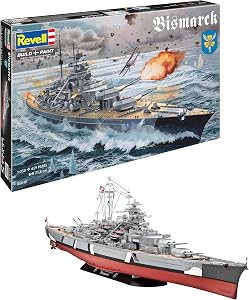 Warships
Battleship Bismarck: History, Camouflage and the Best Model Kits
Bismarck's story, her 1941 fit, Baltic stripes vs. the grey she wore in the Atlantic, and the best Bismarck kits and block sets from 1/1200 to…
Read guide Warships
Yamato vs. Iowa Class: The Last Battleships and Their Kits
Yamato and the Iowa class compared, how USS Missouri changed from 1945 to the 1991 Gulf War refit, and which kit or block set to buy for each ship…
Read guide