Home › Guides › Zero vs Corsair: Kits
Zero vs Corsair: Pacific Air War Versions and Model Kits
BuildAnArmy is reader-supported. When you buy through our Amazon links we may earn a commission, at no extra cost to you. How this works.
The Mitsubishi A6M Zero and the Vought F4U Corsair represent two very different ideas of a fighter. The Zero was light, nimble and had enormous range. The Corsair was big, heavy and fast, built around one of the most powerful engines of the war. Both came in several versions that look different on the shelf, and the kit you buy decides which one you can build. This guide explains the versions, how to tell them apart, and how to paint them correctly.
Two fighters, two philosophies
When Japan entered the war in December 1941, the Zero was its best-known fighter. It had already flown in China from 1940, and it took part in the attack on Pearl Harbor and the early campaigns across the Pacific. Allied pilots who tried to turn with it at low speed paid the price. The Zero's weakness was the cost of its lightness: early versions had no armor for the pilot and no self-sealing fuel tanks, so it could not take much damage.
The Allies learned to fight on their own terms: keep speed up, attack in a dive and climb away, and work in pairs rather than dogfight one on one. A nearly intact Zero recovered in the Aleutian Islands in 1942 was repaired and test-flown in the United States, which helped confirm those tactics.
The Corsair was one of the aircraft that exploited them. It first flew in 1940 and became the first American single-engine fighter to pass 400 mph in level flight. The US Navy at first judged it hard to land on carriers, because the long nose blocked the pilot's view, so Marine Corps squadrons took it into combat first, from land bases in the Solomon Islands in early 1943. The Royal Navy flew it from carriers in 1944, and the US Navy followed. More than 12,000 Corsairs were built, with production continuing into the early 1950s.
Zero versions explained
Zeros carry two kinds of names. The designation A6M means carrier fighter, sixth type, built by Mitsubishi, followed by a number for the sub-type. The Japanese Navy also gave each version a Model number: the first digit changed with the airframe, the second with the engine. Kit boxes often show both, which is confusing at first.
- A6M2 Model 21: the Pearl Harbor and Midway Zero. Its wingtips folded up so it fit carrier elevators. Armed with two 7.7 mm machine guns in the nose and two 20 mm cannon in the wings.
- A6M3 Model 32: a more powerful engine with a two-speed supercharger, and square, clipped wingtips. It carried less fuel, which hurt during the long-range fighting over Guadalcanal. The Allies first thought it was a new type and gave it its own code name, "Hamp".
- A6M3 Model 22: the fix for the Model 32. It went back to the full-span rounded wing with folding tips and added fuel tanks in the wings. The Model 22a (A6M3a) used longer-barrel cannon.
- A6M5 Model 52: from 1943, the most-produced version. It had a shorter, non-folding wing with rounded tips, thicker skin, and separate exhaust stacks around the cowling instead of a single collector, a very easy detail to spot. Later sub-types (52a, 52b, 52c) added more ammunition, heavier guns and armor; the A6M5c added 13.2 mm machine guns in the wings.
In total, more than 10,000 Zeros were built, more than any other Japanese wartime fighter.
| Version | How to spot it | Kits in our catalog |
|---|---|---|
| A6M2 Model 21 | Rounded folding wingtips, single exhaust behind the cowling, early grey finish | Tamiya 1/72 A6M2b (60780), Tamiya 1/32 Model 21 (60317), COBI A6M2 block set |
| A6M3 Model 32 | Square, clipped wingtips | Tamiya 1/48 A6M3 (61025): check the box art for the square wingtips |
| A6M3 Model 22 | Full-span rounded wing like the Model 21, later engine | Tamiya 1/72 Model 22 (60785), Tamiya 1/48 A6M3/3a (61108) |
| A6M5 Model 52 | Shorter rounded wing, individual exhaust stacks | Tamiya 1/48 A6M5/5a (61103), 1/48 A6M5c (61027), 1/32 A6M5 (60318) |
Zero kits by version
Tamiya has covered the Zero more thoroughly than any other maker, and every Zero kit in our catalog is a Tamiya. For a Pearl Harbor or Midway subject, choose a Model 21: the 1/72 A6M2b or the 1/32 Model 21. The 1/32 kit is famous for its detail and suits experienced builders. For the Solomons campaign of 1942 and 1943, the Model 22 or Model 32 is right. For the late war, including the Philippines and the defense of Japan, build a Model 52.

Tamiya Mitsubishi A6M2b Zero Model 21
Tamiya's 1/32 A6M2b Model 21 is the version that flew at Pearl Harbor and Midway, in a large scale with room for a detailed cockpit and engine. It is a showpiece for an experienced builder. Check the listing photos for the markings provided.
Check price on Amazon
Tamiya Mitsubishi A6M3/3a Zero
A 1/48 A6M3/3a Model 22, the Zero of the Rabaul and Solomons fighting. It lets you build the rounded-wing mid-war version in the most popular aircraft scale, from a brand known for kits that go together without fuss.
Check price on Amazon
Tamiya Mitsubishi A6M5/5a Zero
Tamiya's 1/48 A6M5/5a covers the most-produced Zero, with the separate exhaust stacks and shorter wing of the late war. It is the right kit for a dark green Zero from 1944.
Check price on Amazon
Tamiya Mitsubishi A6M2b Zero

Tamiya Mitsubishi A6M3/3a Zero Model 22

Tamiya Mitsubishi A6M3 Zero

Tamiya Mitsubishi A6M5c Zero

Tamiya Mitsubishi A6M5 Zero
Painting a Zero
Early Zeros, including those at Pearl Harbor, were finished overall in a light grey with a slight green or amber tint. The exact shade is still debated, so a light grey-green is a sensible choice. The engine cowling was a very dark blue-black. Carrier units used colored fuselage bands and tail codes to identify their ship and aircraft.
From 1942 onward, field units began to paint dark green over the grey, sometimes in rough blotches, and from 1943 Zeros left the factory in dark green on top with light grey undersides. The red hinomaru on dark green aircraft often had a white outline. Yellow identification strips on the inner leading edges of the wings were added from 1942. A well-worn finish suits a late-war Zero: dark green paint over primer chipped easily, especially around the wing roots and cockpit.
Corsair versions explained
- F4U-1: the first production version had a heavily framed "birdcage" canopy and a low seat. It is not offered in our catalog, but it is good to know when you look at early photos.
- F4U-1A: a raised, clearer canopy with less framing, a higher seat and a longer tailwheel leg, all to improve the view over the nose. "-1A" was a factory and collector label rather than an official Navy designation, but it is how kits and books describe this version. This is the Corsair of the Marine and Navy land-based squadrons in the Solomons, including VMF-214, the "Black Sheep", and VF-17, the "Jolly Rogers".
- F4U-1D: a fighter-bomber with a water-injected engine for extra power, two pylons under the center section for drop tanks or bombs, and fittings for rockets under the outer wings. It flew from carriers and land bases in 1944 and 1945.
- F4U-4: a more powerful engine driving a four-blade propeller, with an air scoop under the cowling. It reached combat in 1945 and was a mainstay of US Navy and Marine Corsair squadrons in the Korean War.
Every Corsair has the inverted gull wing. The bend let the designers keep the landing gear short while giving the huge propeller, about 13 feet across, enough ground clearance. British Corsairs had their wingtips clipped so they could fit below deck on Royal Navy carriers.
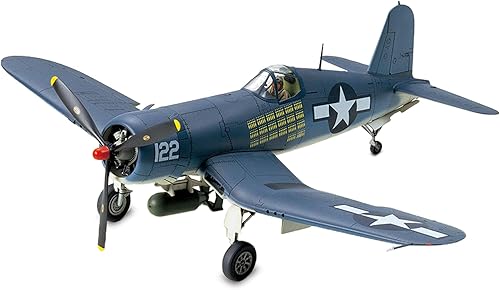
Tamiya F4U-1A Corsair
A 1/48 F4U-1A from Tamiya, the raised-canopy version flown by the famous Marine and Navy squadrons in the Solomons. It suits a tri-color blue scheme. Tamiya's Corsairs are well regarded for fit and clear instructions.
Check price on Amazon
Tamiya F4U-1D Corsair
Tamiya's 1/48 F4U-1D shows the Corsair as a fighter-bomber, with underwing stores for the 1944 and 1945 campaigns. Pick it if you want the glossy dark blue finish of the late war.
Check price on AmazonPainting a Corsair
US Navy colors changed in two big steps, which makes dating your model simple:
- 1942 to early 1943: blue-grey upper surfaces over light grey.
- 1943 to 1944: the tri-color scheme of Sea Blue on top, Intermediate Blue on the sides and white underneath, with soft edges between them. Most F4U-1As wore this scheme.
- From 1944: overall Glossy Sea Blue, which became standard for carrier aircraft. Most F4U-1Ds and all postwar F4U-4s use it.
The national insignia changed too. In mid-1943 the star gained white side bars with a red outline, and from late 1943 the outline was blue. Korean War Corsairs kept the glossy dark blue with white lettering. Weathering on Pacific Corsairs is usually heavy around the wing roots, cowling and gun ports, where crews walked and guns fired.
Tip: The inverted gull wing sets the whole aircraft's stance. Dry-fit the wings to the fuselage and check the dihedral against the front view in the instructions before you glue, because a small error shows up badly on this shape.
More Corsair kits, block sets and RC
Tamiya also makes the F4U-1A (60775) and F4U-1D (60752) in 1/72, and a 1/48 F4U-1D packaged with a deck tractor as a "motor tow set", a ready-made start for a small carrier deck scene. For the F4U-4, choose Revell's long-running 1/48 kit. Revell also makes a 1/32 F4U-1A (04781) if you want a big Corsair.
COBI's Korean War F4U-4 block set and COBI's A6M2 Zero let you build both sides without glue; see the block set guide. For flying models, Volantex sells a P-51D and Zero pair, and there are several foam Corsairs; read RC warbirds for beginners first.

Revell F4U-4 Corsair

Tamiya F4U-1D Corsair, Motor Tow Set
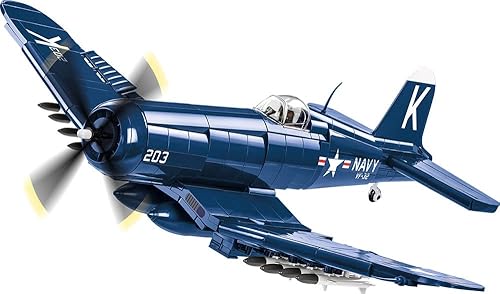
COBI Korean War F4U-4 Corsair, 520 Pieces

COBI Mitsubishi A6M2 Zero

Volantex P-51D Mustang & Zero 2-Pack
If you want to put these fighters in context, a carrier makes a great companion build; our warship guide covers Pacific carriers. And for the American fighter that fought in Europe at the same time, see the P-51 Mustang guide.
Quick answers
Which Zero attacked Pearl Harbor?
The A6M2 Model 21, with folding wingtips and a light grey finish. In our catalog, Tamiya's 1/72 A6M2b and 1/32 Model 21 kits show this version.
What is the difference between the Zero Model 22 and Model 32?
Both are A6M3s with the same engine. The Model 32 has short, square wingtips; the Model 22 returned to the longer, rounded, folding wing and carried more fuel.
How do I tell an F4U-1A from an F4U-1D?
Look under the wings and at the paint. The -1D has pylons for drop tanks or bombs and rocket fittings, and usually wears overall glossy dark blue. Most -1As wear the three-tone blue and white scheme.
Why does the F4U-4 have a four-blade propeller?
Its more powerful engine needed more blade area to turn that power into thrust. The four-blade prop and the scoop under the cowling are the quickest ways to spot a -4.
Which scale is best for Pacific fighters?
1/48 gives the widest choice, especially for Zeros and Corsairs from Tamiya. 1/72 is great for a collection, and 1/32 suits experienced builders.
Keep reading
 Aircraft
The Best WWII Fighter Plane Model Kits
The best WWII fighter aircraft model kits in 1/32, 1/48 and 1/72: P-51 Mustang, Spitfire, Bf 109, Fw 190, Zero, Corsair and Thunderbolt, with tips…
Read guideAircraftP-51 Mustang: P-51B vs P-51D vs F-51D and the Kits to Build
How to tell a P-51B from a P-51D and a Korean War F-51D, which markings fit each, and which Mustang kits, block sets and RC planes show which…
Read guide Aircraft
Spitfire Marks Explained: Mk I, II, V, VIII and IX Model Kits
The Spitfire marks explained: how to spot a Mk I, II, V, VIII and IX, the correct RAF camouflage for each period, and which Spitfire kits depict each…
Read guide