Home › Guides › Spitfire Marks & Kits
Spitfire Marks Explained: Mk I, II, V, VIII and IX Model Kits
BuildAnArmy is reader-supported. When you buy through our Amazon links we may earn a commission, at no extra cost to you. How this works.
The Spitfire was in production for the whole of the Second World War, and it changed constantly. A 1940 Battle of Britain Spitfire and a 1944 Spitfire over Normandy look similar at first glance, but they differ in engine, guns, propeller, radiators and paint. If you want to build an accurate Spitfire, or just pick the right kit, it helps to know the main "marks" (the RAF's word for versions). This guide covers the five you will meet most often in kits.
A fighter that kept growing
Designed by R.J. Mitchell's team at Supermarine, the Spitfire prototype first flew in March 1936, and the first squadron received the type in 1938. Its thin, elliptical wing gave it excellent performance and a shape nobody mistakes. More than 20,000 Spitfires were built, plus the Seafire naval versions.
The secret of its long career was that the airframe could take ever more powerful Rolls-Royce engines. Each new engine and weapon fit became a new mark. In general, the marks fall into two families: the early Spitfires (Mk I, II and V) with the single-stage Merlin, and the later Spitfires (Mk VIII and IX) with the two-stage Merlin 60 series, which brought much better performance at high altitude.
The quickest way to spot early from late
Look under the wings. Early Spitfires have uneven radiators: a large radiator under the right wing and a small round oil cooler under the left. The two-stage Merlin needed an intercooler, so the Mk VIII and IX have two matching radiators, one under each wing. Then look at the nose and propeller: the later marks have a longer nose and a four-blade propeller, where the Mk I to V have three blades (the very first Mk Is had a two-blade wooden propeller).
| Mark | Period | How to spot it | Kits in our catalog |
|---|---|---|---|
| Mk I | 1938 to 1941 | Short nose, three-blade (early two-blade) prop, uneven radiators, eight small machine guns | Tamiya 1/48 (61119), Tamiya 1/72 (60748), COBI and BrixVibe block sets |
| Mk II | 1940 to 1941 | Almost identical to Mk I; small bulge on the right side of the nose for the engine starter | Revell 1/72 Mk IIa (03953), Revell 1/48 Mk II (03959) |
| Mk V | 1941 to 1943 | Short nose, three-blade prop; Mk Vb has two cannon and four machine guns; desert aircraft have a large chin filter | Revell 1/72 Mk V (04164) and Mk Vb (03897) |
| Mk IX | 1942 to 1945 | Longer nose, four-blade prop, matching radiators, fixed tailwheel | Tamiya 1/32 (60319), Revell 1/32 Mk IXc (03927), COBI Mk IXe |
| Mk VIII | 1943 to 1945 | Like a Mk IX but with a retractable tailwheel, small intake under the nose, usually a pointed rudder | Tamiya 1/32 (60320) |
Mk I and Mk II: the Battle of Britain Spitfires
The Mk I was the Spitfire of Dunkirk and the Battle of Britain in 1940. It was armed with eight .303-inch Browning machine guns. Early aircraft had a flat-topped canopy, later replaced by a bulged one that gave more headroom. The propeller changed during 1940 from fixed-pitch to variable-pitch and then constant-speed types, which is why photos show different spinners.
The Mk II, built at the huge new Castle Bromwich factory, had a more powerful Merlin and began reaching squadrons in the late summer of 1940. It is very hard to tell from a Mk I. The easiest clue is a small blister on the right side of the engine cowling that covered its cartridge starter. If you want a Battle of Britain Spitfire that is a little unusual, a Mk II is a nice choice.

Tamiya Spitfire Mk.I
Tamiya's 1/48 Spitfire Mk I is a modern kit that captures the shape of the elliptical wing well. It is the natural choice for a Battle of Britain Spitfire and a very approachable build for a newer modeler. Check the listing for the marking options included.
Check price on AmazonMk V: the workhorse of 1941 and 1942
The Mk V took a stronger Merlin 45 series engine and became the most numerous single mark. It flew over France, defended Malta, fought in North Africa and served in the Far East. Mk Vs came with different wings: the Vb, the most common, had two 20 mm cannon and four machine guns; the Vc had a "universal" wing that could take several gun fits.
Two features make Mk Vs look different. Aircraft sent to the Mediterranean got a large tropical air filter under the nose, which gives the chin a deep, heavy look. Some low-altitude Mk Vs had their rounded wingtips replaced with short, square "clipped" tips. When the German Fw 190 appeared in 1941, it outclassed the Mk V, which led directly to the Mk IX.

Revell Spitfire Mk.Vb
A 1/72 Spitfire Mk Vb from Revell, the most common Mk V wing type with its cannon armament. 1/72 is a good way to build a small collection of marks side by side. Check the listing photos for which filter and wingtip options it includes.
Check price on AmazonMk IX: the answer to the Fw 190
The Mk IX was meant as a stopgap: a Mk V airframe with the two-stage Merlin 61. It entered service in the summer of 1942 and was such a success that it stayed in production to the end of the war, becoming the second most numerous mark. It flew over Dieppe, Normandy and into Germany.
Within the Mk IX, the wing tells you the sub-type. The Mk IXc had the universal C wing, usually with two 20 mm cannon and four machine guns. The Mk IXe had the E wing, which replaced the four small machine guns with two heavier .50-caliber guns and moved the cannon outboard. Late-production Mk IXs often have a broad, pointed rudder.

Tamiya Spitfire Mk.IX
Tamiya's 1/32 Spitfire Mk IX is widely regarded as one of the finest large-scale propeller-fighter kits ever made, with very involved engineering. It is a project for experienced builders. If you want a large Mk IX that is easier going, Revell's 1/32 Mk IXc is the alternative.
Check price on AmazonMk VIII: the refined version
While the Mk IX was rushed into service, Supermarine developed the Mk VIII as the properly redesigned airframe for the two-stage Merlin. It had a strengthened fuselage, extra fuel in the wings and a retractable tailwheel, the easiest way to tell it from a Mk IX. A small tropical filter under the nose was standard. Most Mk VIIIs went to the Mediterranean, Burma and the Pacific, including Australian squadrons, rather than to Northern Europe.
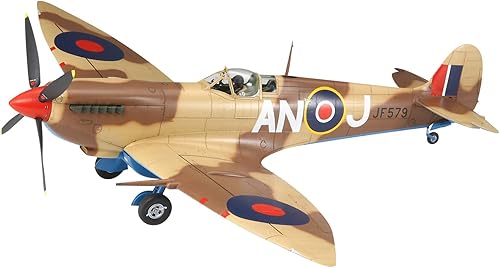
Tamiya Spitfire Mk.VIII
Tamiya's 1/32 Mk VIII shares the reputation of its Mk IX sister kit. It is the way to build a Spitfire in Mediterranean or Southeast Asian markings, which look very different from the usual European greys and greens.
Check price on AmazonCamouflage by period
RAF paint changed on set dates, which makes it easy to choose the correct scheme once you know when your aircraft flew.
- 1938 to mid-1940: Dark Green and Dark Earth on top. Undersides were often split black (left wing) and white (right wing), sometimes with silver areas.
- Battle of Britain, summer 1940: the same upper colors with Sky, a pale duck-egg green, on the undersides. From late 1940, fighters also carried a Sky spinner and a Sky band around the rear fuselage.
- From August 1941: the Day Fighter Scheme of Ocean Grey and Dark Green on top, Medium Sea Grey below, Sky spinner and band, and yellow strips on the outer wing leading edges. This is the look of most Mk Vs and Mk IXs in Northern Europe.
- Mediterranean and desert: Dark Earth and Middle Stone on top with Azure Blue below, often on tropical Mk Vs.
- 1944: Mk IXs supporting D-Day carried black and white invasion stripes. Spitfires in Burma and India used blue and light blue roundels without the red center, to avoid confusion with Japanese markings.
National markings changed as well. During 1940 the fuselage roundel gained a yellow outer ring, and in 1942 the proportions changed again, with thinner white and yellow rings. A themed Allied paint set covers most of these colors; see our WWII fighter guide for general painting advice.
Tip: The wavy camouflage pattern on RAF fighters was applied from templates in the factory, so it was fairly consistent. Use the painting diagram in your instructions, and draw the pattern lightly in pencil before you mask or brush it.

Tamiya Spitfire Mk.I

Revell Spitfire Mk.IIa
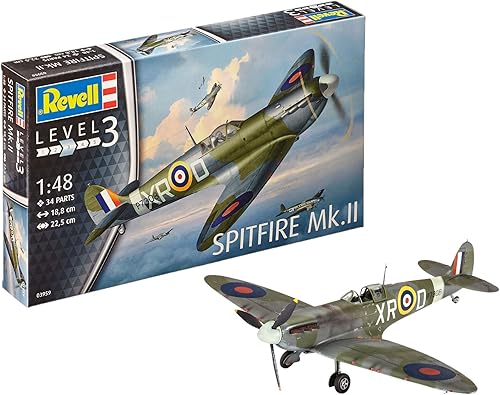
Revell Spitfire Mk.II

Revell Spitfire Mk.V

Revell Spitfire Mk.IXc
Common Spitfire build pitfalls
- Mixing parts from different marks. Kits often include parts for several versions. Decide on your mark first and mark the unused parts on the instruction sheet.
- Thin wing trailing edges. The Spitfire wing is very thin. Glue the upper and lower halves carefully and clamp them so the trailing edge does not end up thick or gapped.
- Narrow landing gear. The undercarriage legs splay outward at an angle. Check the front view in the instructions so the model sits correctly.
- Canopy position. The sliding hood can be built open, which shows off the cockpit. Paint the cockpit interior first; most RAF fighters had a grey-green interior.
Block sets and RC Spitfires
For a no-glue Spitfire, COBI makes a Mk I tied to the Imperial War Museum and a later Mk IXe, which is a neat way to show the early and late shapes side by side. BrixVibe offers another Mk Ia. If you want to fly one, foam Spitfire park flyers exist too; read RC warbirds for beginners first. Building a Mustang next? Our P-51 Mustang guide covers the American escort fighter that flew alongside late-war Spitfires.

COBI Spitfire Mk.I (Imperial War Museum), 146 Pieces

COBI Supermarine Spitfire Mk.IXe

BrixVibe Supermarine Spitfire Mk.Ia

HAWK'S WORK Spitfire Warbird
Quick answers
Which Spitfire fought in the Battle of Britain?
Mainly the Mk I, with the Mk II joining from late summer 1940. Paint it Dark Green and Dark Earth over Sky.
What is the easiest way to tell a Mk IX from a Mk V?
The Mk IX has a longer nose, a four-blade propeller and two matching radiators under the wings. The Mk V has a three-blade propeller and uneven radiators.
What do the letters after the mark mean, like Vb or IXe?
They describe the wing and armament. A "b" wing carried two cannon and four machine guns, "c" was a universal wing, and "e" replaced the small machine guns with two .50-caliber guns.
Which scale is best for a first Spitfire?
1/48. Tamiya's 1/48 Mk I is an easy, accurate kit. Save the 1/32 Tamiya Mk VIII and Mk IX for when you have a few builds finished.
Were all Spitfires green and brown?
No. That scheme lasted until August 1941. Later Spitfires in Europe were grey and green, and desert aircraft were sand and brown over blue.
Keep reading
 Aircraft
The Best WWII Fighter Plane Model Kits
The best WWII fighter aircraft model kits in 1/32, 1/48 and 1/72: P-51 Mustang, Spitfire, Bf 109, Fw 190, Zero, Corsair and Thunderbolt, with tips…
Read guideAircraftP-51 Mustang: P-51B vs P-51D vs F-51D and the Kits to Build
How to tell a P-51B from a P-51D and a Korean War F-51D, which markings fit each, and which Mustang kits, block sets and RC planes show which…
Read guide Aircraft
Zero vs Corsair: Pacific Air War Versions and Model Kits
The A6M Zero Model 21, 32, 22 and 52 and the F4U Corsair -1A, -1D and -4 explained: how to spot each, correct paint and markings, and kits for every…
Read guide