Home › Guides › B-17 & Lancaster Bombers
B-17 and Lancaster: Heavy Bomber History and Model Kits
BuildAnArmy is reader-supported. When you buy through our Amazon links we may earn a commission, at no extra cost to you. How this works.
The Boeing B-17 Flying Fortress and the Avro Lancaster were the two great four-engine bombers of the air war over Europe. They look similar at a glance and are almost the same size, but they were built for very different ways of fighting. This guide explains how they differed, how to tell the B-17 versions apart, the stories behind the Memphis Belle and the Dambusters, and what to expect from a bomber kit in each scale.
Two bombers, two ways of fighting
The US Army Air Forces flew the B-17 in daylight, in tight formations, aiming at specific targets such as factories and rail yards. The bombers relied on heavy defensive guns to protect each other. That is why a late B-17 bristles with machine guns.
RAF Bomber Command flew the Lancaster mostly at night, when fighters had trouble finding bombers. It carried fewer and lighter guns but a much heavier bomb load. The Lancaster's long, unobstructed bomb bay could carry very large bombs, which later made it the only aircraft able to drop the 22,000-pound Grand Slam.
| B-17 Flying Fortress | Avro Lancaster | |
|---|---|---|
| First flight | 1935 | 1941 |
| Number built | About 12,700 | About 7,400 |
| Wingspan | 31.6 m (103 ft 9 in) | 31.1 m (102 ft) |
| Length | About 22.7 m (B-17G) | About 21.2 m |
| Engines | Four Wright Cyclone radials | Four Rolls-Royce or Packard Merlin V-12s |
| Crew | 10 | 7 |
| Defensive guns | Up to 13 .50-caliber (B-17G) | Mostly .303-inch, in nose, mid-upper and tail turrets |
| Typical finish | Olive drab over neutral gray, later bare metal | Dark green and dark earth on top, black underneath |
B-17F vs. B-17G: how to tell them apart
The B-17F and B-17G were the two main combat versions over Europe. The G was the most numerous of all, with more than 8,000 built. The easiest difference is under the nose.
| Feature | B-17F | B-17G |
|---|---|---|
| Chin | No chin turret. A clean, rounded clear nose. | A two-gun chin turret under the nose |
| Nose guns | Hand-held guns, with cheek guns added on later aircraft | Chin turret plus cheek guns |
| Waist windows | Open waist positions, directly opposite each other | Later aircraft had enclosed, staggered waist windows |
| Tail | Original tail gun position | Later aircraft had the improved "Cheyenne" tail turret with larger windows |
| Finish | Olive drab over neutral gray | Olive drab on early aircraft, bare metal on many from 1944 |
The chin turret was added because German fighters had learned to attack B-17s head-on, where the early versions had the weakest defense. A silver B-17G with colorful group markings on the tail is one of the classic late-war looks.
The Memphis Belle
The Memphis Belle was a B-17F of the 91st Bomb Group, based at Bassingbourn in England. In May 1943 her crew, led by pilot Robert Morgan, became one of the first US heavy bomber crews to complete 25 combat missions and return home. At that stage of the war, finishing a tour was far from certain, and the crew went on a publicity tour of the United States.
Director William Wyler's 1944 documentary made the aircraft famous, and a 1990 feature film retold the story. The real Memphis Belle has been restored and is displayed at the National Museum of the US Air Force in Dayton, Ohio.
For modelers, the Belle is an olive drab and neutral gray B-17F. Her nose art and mission markings are the focal point. Apply them over a gloss coat so the decals settle without silvering, then seal them with a matt or satin coat.
The Lancaster and the Dambusters
The Lancaster grew out of a failure. Avro's twin-engine Manchester suffered from unreliable engines, so the design was enlarged with a longer wing and four Merlins. The result first flew in January 1941 and entered service in 1942. The Mk.I and Mk.III look almost identical outside. The main difference is that the Mk.III used American, Packard-built Merlins. That is why kits are often labeled "Mk.I/III."
The Lancaster's most famous mission was Operation Chastise, on the night of 16 to 17 May 1943. The newly formed No. 617 Squadron, led by Wing Commander Guy Gibson, attacked dams in Germany's Ruhr region with Barnes Wallis's "bouncing bomb," codenamed Upkeep. The Möhne and Eder dams were breached. The cost was high: of 19 aircraft sent, 8 did not return. Gibson was awarded the Victoria Cross.
How a Dambuster Lancaster differs
- No bomb bay doors. They were removed so the large cylindrical Upkeep could hang beneath the fuselage.
- No mid-upper turret. It was removed to save weight. The top of the fuselage behind the wing is smooth.
- Upkeep and its mounting. The bomb was held between two V-shaped arms and spun backward before release so it would skip across the water.
- Very low flying. The attack was made at about 60 feet over the water. Spotlights under the aircraft helped crews judge their height.
So a standard Lancaster kit cannot become a Dambuster without major changes. Buy a Dambusters kit if that is the version you want.
Two Lancasters still fly today: one with the Battle of Britain Memorial Flight in the UK and one with the Canadian Warplane Heritage Museum.
How big do these models get?
This catches many people out. A heavy bomber in 1/48 is not a small model.
| Aircraft | 1/72 span x length | 1/48 span x length |
|---|---|---|
| B-17 | About 44 x 31 cm | About 66 x 47 cm |
| Lancaster | About 43 x 29 cm | About 65 x 44 cm |
| For comparison: P-51D fighter | About 16 x 14 cm | About 24 x 21 cm |
A 1/48 B-17 has a wingspan close to two feet, nearly as wide as a 1/350 battleship is long. If shelf space is tight, 1/72 gives you a big, impressive model that still fits a normal bookcase. A wall bracket or a hanging display is another option for 1/48.
The kits
B-17
Revell covers both major versions. In 1/72 there is a B-17F Memphis Belle and a B-17G. In 1/48 there is a B-17F Memphis Belle. Revell's large bomber kits are a common choice because few brands make these big subjects at all.

Revell B-17F Memphis Belle
Revell's 1/48 B-17F Memphis Belle builds into a model with a wingspan of about 66 cm. It depicts the most famous Flying Fortress of all, in the olive drab scheme that is relatively easy to paint well.
Check price on Amazon
Revell B-17G Flying Fortress
Revell's 1/72 B-17G Flying Fortress, the most-produced version, with the chin turret. A manageable size for a first bomber, and a good partner for the 1/72 Memphis Belle if you want to show the F and G side by side.
Check price on AmazonLancaster
Tamiya's 1/48 Lancaster is the large-scale choice, from a brand known for good fit. Revell offers two 1/72 kits: a standard Mk.I/III and the B.III Dambusters version with the modified fuselage.

Tamiya Avro Lancaster B Mk.I/III
Tamiya's 1/48 Avro Lancaster B Mk.I/III. A large model with Tamiya's reputation for engineering, which helps on a four-engine aircraft where wing and engine alignment really matter.
Check price on Amazon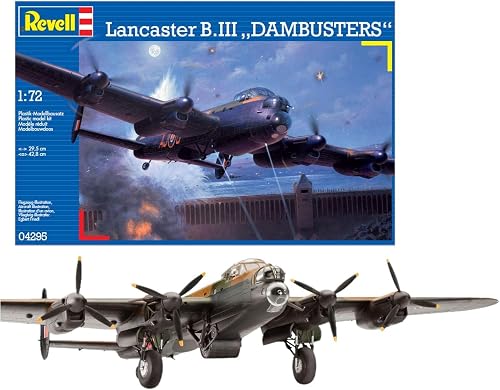
Revell Avro Lancaster B.III Dambusters
Revell's 1/72 Lancaster B.III Dambusters. Build Gibson's raid aircraft with the Upkeep bomb and the missing mid-upper turret, at a size that fits a normal shelf.
Check price on AmazonBlock sets
COBI makes both B-17 versions, an F as the Memphis Belle and a G, plus a Lancaster Dambuster and a Lancaster of No. 300 Squadron. No. 300 was a Polish bomber squadron of the RAF that flew Lancasters from 1944, a natural subject for a Polish brand. Sluban, Cuusmet and IWonders also offer B-17s. COBI's bomber range continues with the B-24 Liberator, He 111 and Mosquito if you want to build a collection.
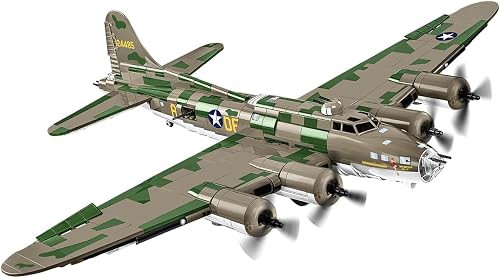
COBI Boeing B-17F Flying Fortress Memphis Belle

COBI Boeing B-17G Flying Fortress

COBI Avro Lancaster B.III Dambuster

COBI Avro Lancaster B Mk.I/III (300 Sqn RAF)

COBI Consolidated B-24D Liberator
Building a four-engine bomber
- Align the engines. Four nacelles and four propellers must line up. Check them from the front before the glue sets.
- Lots of clear parts. Bombers have many windows and turrets. Glue them with a clear-drying canopy glue, not plastic cement, and mask them before painting.
- No nose weight needed, usually. Both aircraft sit on a tail wheel, so they do not tip back like tricycle-gear jets. Always follow the kit instructions, though.
- Get the wing joint right. The long wings must meet the fuselage at the correct upward angle. Dry-fit, then hold or tape them while the cement cures.
- Decide on the bomb bay early. Open bomb doors look great, but you need to paint the bay interior before closing up the fuselage.
- Paint planning. For a Lancaster, paint the black undersides first, then mask for the green and brown camouflage. For an olive drab B-17, a lighter mist on the upper surfaces suggests sun fading.
For smaller WWII aircraft, see our WWII fighter kit guide. For tools and glue, start with the first model kit guide.
Quick answers
Which is bigger, the B-17 or the Lancaster?
They are very close. The B-17 has a slightly wider wingspan and a slightly longer fuselage, so the models take up almost the same space.
How do I tell a B-17F from a B-17G?
Look under the nose. The B-17G has a two-gun chin turret; the B-17F does not.
What was special about the Dambuster Lancasters?
They were modified to carry the Upkeep bouncing bomb: bomb bay doors and the mid-upper turret were removed, and a rig held and spun the bomb under the fuselage.
Is 1/48 or 1/72 better for a bomber?
1/72 for most people. The models are still large, around 43 to 44 cm across the wings, and much easier to display. Choose 1/48 for a true showpiece.
Do bomber block sets need paint?
No. Brick-built bombers need no glue or paint, and COBI's sets use historically based markings.
Keep reading
 Aircraft
The Best WWII Fighter Plane Model Kits
The best WWII fighter aircraft model kits in 1/32, 1/48 and 1/72: P-51 Mustang, Spitfire, Bf 109, Fw 190, Zero, Corsair and Thunderbolt, with tips…
Read guideAircraftP-51 Mustang: P-51B vs P-51D vs F-51D and the Kits to Build
How to tell a P-51B from a P-51D and a Korean War F-51D, which markings fit each, and which Mustang kits, block sets and RC planes show which…
Read guide Aircraft
Spitfire Marks Explained: Mk I, II, V, VIII and IX Model Kits
The Spitfire marks explained: how to spot a Mk I, II, V, VIII and IX, the correct RAF camouflage for each period, and which Spitfire kits depict each…
Read guide